Urban Surplus
I chose to study architecture out of a core belief that the built environment has the capacity to improve human relationships, rather than simply enclose them. I am particularly drawn to projects that serve a broad public, such as multi-family housing, civic infrastructure, and public space, due to their direct impact on people's daily lives.
My interest in how culture shapes architecture led me to study in São Paulo and Tokyo. Studying at the University of São Paulo shifted my focus toward urbanism, exposing me to a complex metropolis and a strong curriculum in urban theory. After completing my Master’s at the University of Porto, I moved to Japan as a research scholar at Tokyo University of the Arts (Geidai). There, under Ryuji Fujimura, I explored Arata Isozaki’s "hyper village" theory and engaged in participatory construction projects in Fukushima, deepening my understanding of community-led local development and high-density urban dynamics.
Lisbon remains a heavily car-centric city, dedicating vast amounts of public space to vehicular traffic and parking. This spatial inequality results in frequent traffic accidents, air pollution, and a critical shortage of pedestrian space. While European capitals actively transition toward sustainable mobility, Portugal lags behind—presenting a clear opportunity to reclaim car-dedicated areas for civic life. As urban speed limits decrease, narrowing oversized lanes unlocks a significant "urban surplus" for pedestrian use.
Simultaneously, Lisbon faces severe climate vulnerability. Excluding Monsanto Forest Park, Lisbon has one of the lowest tree canopy densities among European capitals, suffering from extreme heat island effects despite its 2020 European Green Capital title. Repurposing this infrastructural asphalt surplus offers a direct spatial opportunity to introduce soil permeability, shade, and urban cooling into dense neighborhoods.
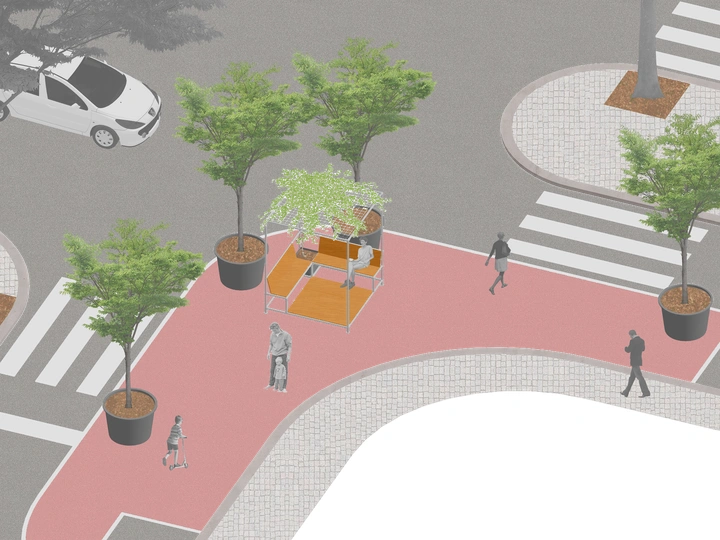
In June 2026, I initiated re-treat, a project applying this methodology to an oversized intersection in Lisbon. By redrawing the street alignment, the proposal reclaimed excess lane widths to create a shaded public space for rest, gathering, and micro-climate adaptation. I presented this design directly to the Lisbon City Hall during a public municipal meeting, where it initiated a debate on tactical asphalt conversion, and I am currently working toward its physical realization.
Moving forward, I envision expanding this framework into a systemic, city-wide analysis of Lisbon. The goal is to map urban spatial surpluses systematically and develop a catalog of adaptable, climate-resilient spatial interventions, scaling re-treat from a local tactical project into a broader toolkit for Southern European cities.