Architecture of the Adjacent Possible
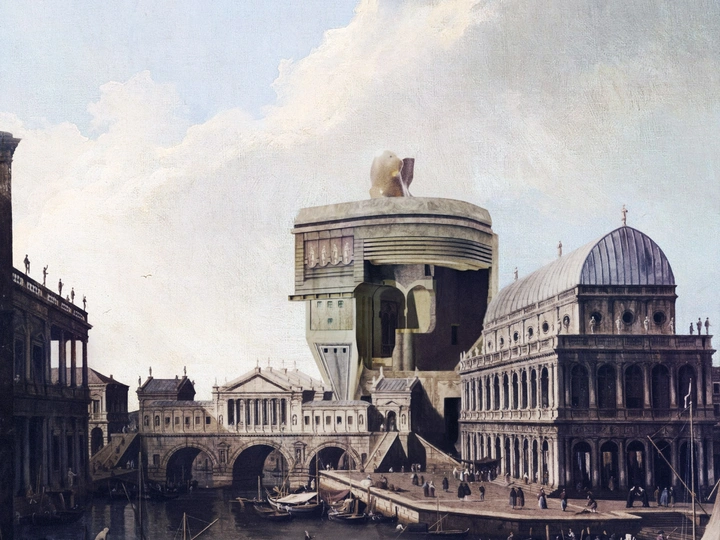
I am an architect, designer, writer, and researcher working across architectural design, artistic practice, theory, and exhibition-making. I completed my PhD at the University of Innsbruck in 2025 with the dissertation Genealogies of Affinity: Piranesi and Syncretic Architecture, which examined architectural form as the outcome of translations between conflicting traditions and cultural contexts. Since 2017, I have worked as a research and teaching assistant at the Institute of Architectural Theory at the University of Innsbruck, where I have taught design studios on realism, fiction, style, imitation, excess, and architectural estrangement. Since 2023, I have also collaborated with Studio Sam Jacob at the Institute of Architecture of the University of Applied Arts Vienna, contributing to master studios, thesis teaching, and research projects. My practice develops through installations, drawings, exhibitions, public art, and speculative design. Current work includes Tower of Amras, a public art project in Innsbruck designed with Mathias Bank and winner of the KÖR Kunst im öffentlichen Raum Tirol competition. Previous projects include TRANSformING, an exhibition reworking Hans Hollein’s MAN Transforms; Hypnerotomachia Naturae, developed for the Tiroler Landesmuseum; Frank Variation, shown in Veszprém; and Quasi-Theory / Quasi-Project for the Unfolding Pavilion in Venice. Alongside practice and teaching, I publish on architectural theory, representation, realism, collage, digital architecture, and cultural memory. My texts have appeared in Architectural Design, Daidalos, ArchDaily, Routledge volumes, and the Enciclopedia Italiana Treccani. I have lectured at institutions including ETH Zürich, Chalmers, TU Delft, and the Swiss Institute in Rome. My aim is to connect historical research with contemporary design practice, challenging the frankly absurd divide between disciplinary discourse and practice, while testing the boundaries between theory and design.
“The Adjacent Possible” is an exhibition and research project that explores how architecture generates the new by transforming what already exists, in the broadest sense. Architecture rarely begins from nothing; it works through inherited forms, materials, images, techniques, and cultural references, which can be copied, displaced, combined, altered, and given new meanings. One of the project’s distinctive aims is to highlight that architects invent through the continuous transformation of existing forms. The research develops Stuart Kauffman’s concept of the adjacent ‘possible’: the set of possibilities that lies one step beyond a given condition and can emerge through the rearrangement of elements already present. Applied to architecture, this idea offers a framework for understanding how existing material can, through new combinations, lead to forms that were not previously there. The project can bring this perspective to life through a combination of historical research and contemporary design experimentation (or both) in an exhibition setting, or in one of the formats. The historical component examines the extent to which architects have transformed precedents, vernacular forms, building systems, and cultural iconographies through works, drawings, and objects. The contemporary section may invite architects and designers to make explicit the processes through which transformations of precedents were carried out. At the same time, the exhibition supports the agenda and can incorporate design research by bringing together drawings, models, speculative reconstructions, and site-specific installations. These works engage in operations such as quotation, variation, montage, hybridization, estrangement, and recomposition. This is why 'Lina Community' would be great: to develop such possibilities for my own work as well (and, most importantly, to discuss this topic and generate a platform, an ‘adjacent’ one, to question authorship and the myths of design).