Kitchens of commons
Côme Mazin-Pietri
Hippolyte Roger
Alex Roux
Collectif.zip brings together young architects, designers, and urban planners from a variety of backgrounds. Active since 2022, this collaboration allows us to experiment and enrich our practice by engaging with interdisciplinary issues. The group currently consists of four core members—Ronan Le Cornec, Alex Roux, Hippolyte Roger, and Côme Mazin-Pietri—joined on a project basis by a broader network of friends, colleagues, craftspeople, and designers. Our complementary skill sets enable us to develop a truly holistic perspective.
Our approach connects diverse scales of work, from bioregional dynamics to self-build construction, while examining changing urban contexts. We place a strong emphasis on reuse and the use of bio- and geo-sourced materials as fundamental to the act of building, alongside exploring the impact of climate change on coastal areas and the evolution of local food systems. We also seek to rethink the design process through knowledge-sharing, whether via public consultation, participatory building projects, workshops, or intensive training sessions.
Since 2023, our work has been recognised through a FAIRE 2025 grant (the Paris Pavillon de l’Arsenal’s research incubator), several awards in the Europan 18 competition, and an honourable mention in the Greater Paris Metropolitan Area’s call for artistic projects.
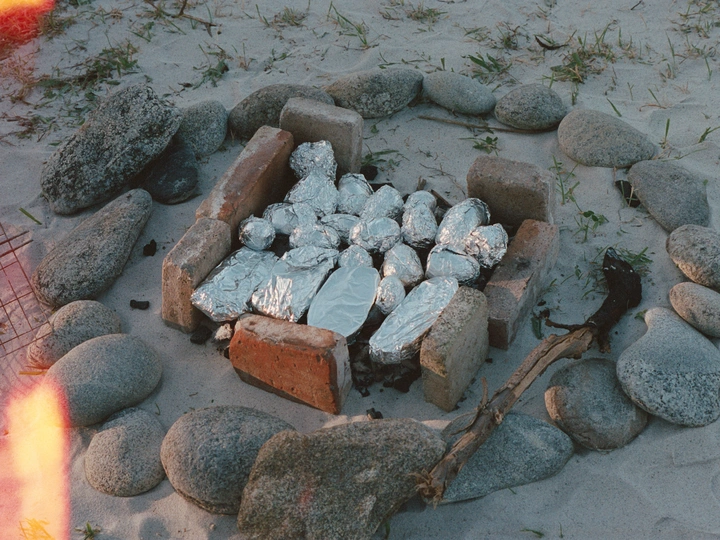
This spatial, social, and culinary initiative accompanies contemporary transformations across our regions: industrial estates in transition, construction sites, brownfields, and landscapes disrupted by climate change. At the crossroads of design, architecture, and cuisine, it uses the meal as a tool for political and ecological mediation. We have practiced this approach through few years of research ("La Cuisine du Grand-Paris", "Four de chantier", "Plantes Sauvages", "PAV dining room", etc.).
Adaptive and circular architecture
Inspired by industrial and agricultural logistics, the pavilion is lightweight, modular, and fully demountable. Built from local and reused materials (steel, decommissioned timber, excavated earth), its design adapts to available resources and site constraints. Whether standalone or integrated into a larger setup, the pavilion hosts exhibition spaces (maps, local narratives). At its heart, a versatile work surface surrounds the hearth—a central element of symbolic significance.
The kitchen as an active archive
The space is supplied by a larder stocked with produce from local artisans, supplemented by gleaning—a practice challenging mass retail and global agribusiness. The kitchen transforms raw produce into nourishing vegetarian dishes accessible to all. It incorporates low-tech preservation techniques that extend seasonal availability, allowing diners to take home a culinary souvenir.
The meal as a ritual of social mobilisation
Taking place over a day or evening, the project subverts conventional site uses (car parks, building sites, coastlines). By disrupting temporal rhythms, it invites residents, workers, and passers-by to rethink their surroundings. The layout encourages wandering and informal encounters, breaking down hierarchies. People gather to peel, cook, discuss, and share skills. The banquet becomes a moment of democratic celebration and collective consciousness, enabling people to reconnect with their local area.