Living Glass Landscapes
I am a multidisciplinary material designer and researcher exploring new relationships between living systems, material production, and the built environment. My practice investigates how we can rethink resources by learning from natural ecosystems and integrating their dynamics into human-made processes.
I began my studies in biology at the Freie Universität Berlin and Università degli Studi di Milano, where I developed an interest in the complexity and resilience of living systems. An internship in a studio working with bacterial cellulose introduced me to bio-based materials as tools for ecological transformation, leading me to pursue a Master’s degree in Design through New Materials at Elisava School of Design and Engineering in Barcelona. There, I founded Orsa Studio, a research-based practice exploring alternative ways of engaging with natural systems through material experimentation.
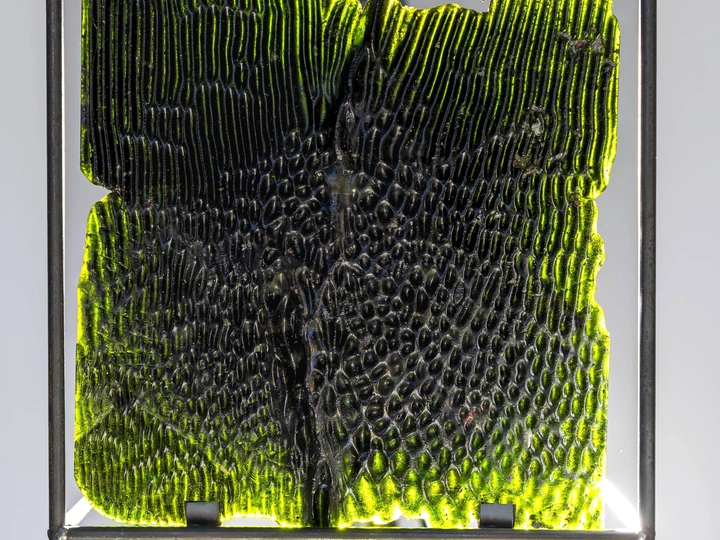
My current research focuses on microalgae as a material resource, combining scientific inquiry, design research, and craft-based experimentation. Through collaborations with scientists, laboratories, and makers, I investigate how biological processes can challenge conventional systems of material production. My main project, Sea Glass, explores the development of glass from cultivated biosilica produced by microalgae, questioning extractive models of mineral production and exploring the possibility of growing mineral resources rather than solely extracting them.
Sea Glass has been developed through collaborations with the Institut de Ciències del Mar in Barcelona, the Brightlands Chemelot Campus within the Jan van Eyck Academie Future Materials Fellowship, and glass practitioners. My work has been recognised through the Elisava Master Award 2024, the IF Student Award, and the Next Gen Design competition.
Through my practice, I seek to develop not only new materials, but new ways of understanding the relationships between resources, ecosystems, and human practices.
For centuries, architecture has relied on materials that have been progressively extracted, transformed, and standardized. Through industrialization, materials have reached unprecedented levels of technical performance, precision, and predictability. Yet this process has also made invisible the histories embedded within them: the landscapes they originate from, the resources they depend on, the labour and energy behind them, and the ecological consequences of their production.
The emergence of regenerative materials invites us to rethink not only what materials are made of, but also how we relate to their origins. Unlike industrial materials designed for uniformity, regenerative materials are shaped by biological processes, local conditions, and ecological relationships. Their variations are not imperfections to eliminate, but traces of the systems that produced them.
This proposal is grounded in my ongoing work on Sea Glass, a glass material developed from cultivated biosilica produced by microalgae. The project emerged from a desire to challenge conventional mineral production systems and the extractive logic behind them by exploring the possibility of growing mineral resources rather than solely extracting them. Through this material, I investigate how regenerative processes could redefine our relationship with resources, shifting from finite geological extraction towards renewable systems of material production.
Through collaborative research with architects, designers, and students, this proposal explores how Sea Glass can inform spatial practices. Material experiments and prototyping will investigate how the inherent variations of biologically grown glass can become architectural qualities rather than constraints, challenging the expectation of uniformity in construction. The outcome will be a collection of spatial prototypes and design principles proposing a first framework for integrating regenerative material variability into architectural practice.