Play Sculptures
I am a Brazilian architect currently pursuing a PhD in Architecture at the Faculty of Architecture of the University of Porto (FAUP). I hold a degree in Architecture and Urbanism from the Federal University of Pelotas (UFPel), Brazil, and studied at the École Nationale Supérieure d’Architecture et de Paysage de Lille, France, as a recipient of the Ciência sem Fronteiras scholarship. Throughout my professional career, I have worked at Studio Arthur Casas and Metro Arquitetos in São Paulo, and more recently at Carvalho Araújo in Portugal, contributing to architectural projects across different scales and contexts. My interests focus on the relationship between architecture, photography, cities, and visual culture, exploring how images can contribute to both architectural research and practice. I have participated in research groups and study programs dedicated to photography, technology, and urban imaginaries, published work on architecture and territory, and exhibited my photographic work in Brazil and internationally, including exhibitions in Kyoto and Tokyo. Among the recognitions I have received are second place in the Ibero-American Student Competition on Bioclimatic Architecture and finalist selection in the Kaira Looro competition.
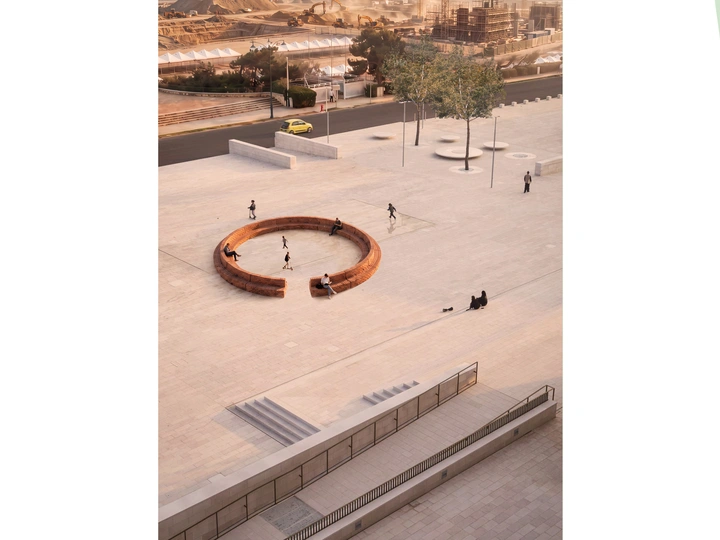
This project introduces a temporary “borrowing” stage into the construction cycle. Between the moment construction waste leaves the building site and its next destination (recycling, reuse, or disposal (materials are temporarily relocated into public space, where they become objects of experimentation, learning, and collective engagement.
Rather than understanding architecture solely as the production of buildings, the project explores architecture as the production of relationships between bodies, materials, and space. Each installation uses waste sourced from nearby construction sites, creating a direct connection with its territory. In this way, each intervention becomes a temporary portrait of the neighborhood’s material metabolism, making visible otherwise hidden flows of construction, transformation, and circulation.
The project also challenges the idea of architectural creation as a closed process. The construction site is understood as a space of collective intelligence, improvisation, and knowledge, recognizing the expertise and solutions developed by workers as part of architectural production. Authorship becomes a shared process shaped by practices emerging on site.
The installations also restore a tactile and embodied dimension to urban experience. Through movement, balance, touch, and spatial awareness, they invite people to engage with materials and public space differently. What is usually perceived as discard becomes an opportunity to experience, learn, and imagine new possibilities for resources already in circulation.
Flexibility is fundamental: there is no definitive form. Each installation responds to the available materials and the specific conditions of its site. The pieces function as open systems, capable of incorporating new components or releasing others back into cycles of reuse and recycling. The project thus remains a living system, continuously transforming alongside the materials and the city.