The Object Before Space
I am a Syrian architect and independent researcher currently based in Barcelona. My work moves between architecture, visual culture, and moving image, exploring architecture not only as the production of buildings but as a way of understanding how ideas become material. I am interested in the systems that exist before architecture—rituals, symbols, texts, and cultural narratives—and how they eventually shape the spaces we inhabit.
I studied architecture in Damascus before moving to Barcelona to pursue a Master's in Advanced Architecture at IAAC. The transition between these two contexts fundamentally changed my way of thinking. While my academic work focused on computational design, urban morphology, and AI-assisted design tools, my independent research gradually moved in a different direction, investigating architecture through cultural, philosophical, and visual inquiry. Rather than seeing these interests as separate, I work between them, combining computational thinking with historical and spatial research.
Alongside my professional practice, I founded RE68 as an independent platform for architectural research and visual experimentation. Through films, conceptual drawings, mapping, and digital media, I develop projects that use visual production as a way of generating knowledge rather than simply representing it. I am particularly interested in how contemporary visual culture can become a legitimate space for architectural research, reaching audiences beyond academic and professional circles.
My practice is driven by curiosity more than discipline. I move between architecture, philosophy, religion, anthropology, and digital culture, looking for relationships that are often overlooked when these fields are studied independently. Whether working through research, design, or moving image, I am interested in developing new ways of observing arch
The Object Before Space investigates the spiritual object as a technology of abstraction between belief and space. It shifts attention from architecture to the processes that precede it: the objects, symbols, texts, geometries, orientations, and rituals through which communities translate their understanding of reality into material form. Architecture is understood not as the origin of these ideas, but as one of their consequences.
The project does not compare religions. It compares modes of abstraction, asking how different traditions compress complex cosmological ideas into forms that can be inhabited, repeated, and transformed. The orientation of a mosque toward the qibla, the textual constellations of Ibn Arabi, and the geometric logic of the lotus within Buddhist traditions are studied as distinct yet comparable operations through which abstract ideas acquire spatial order.
The research now extends toward contemporary secular ritual, beginning with the rave. Without an inherited cosmology, it still performs the same operations: a community gathers, orients itself, and through sound, darkness, and light produces a temporary space that functions as sacred. The sound system becomes a point of orientation, a secular qibla, and the crowd gathers around it like a mandala in motion.
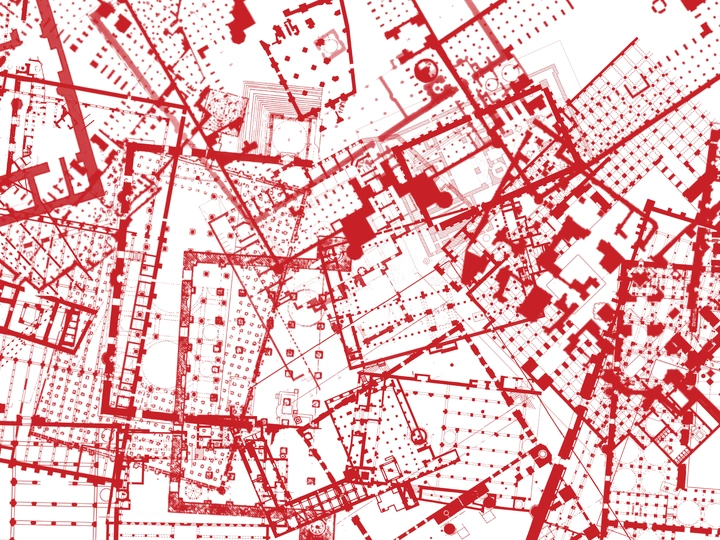
Drawing, mapping, moving image, and projection are not tools of representation but instruments of research. Visual production becomes a way of thinking, and the digital realm operates as a public laboratory where these ideas are tested through circulation and collective response. The accompanying films and drawings are active components of the investigation, an evolving visual atlas rather than documentation.
The project remains open-ended, grounded in a single proposition: before architecture becomes space, it first exists as an act of abstraction.