Soil and Dung: Biotic Architecture in the Caucasus
Hacer Bozkurt
Bart Feberwee
Ecem Sarıçayır
Bart Feberwee works in the field of political theory, and Ecem Sarıçayır is an architect, architectural historian, and educator. In this work, they collaborate with Hacer Bozkurt, architect and architectural photographer. Feberwee is a PhD Candidate at the History of Consciousness program at the University of California, Santa Cruz. His most recent publication is titled “The American Wasteland: Grace Lee Boggs and James Boggs on the Ecology of Racialization” and was published in the journal, Capitalism Nature Socialism. He is the assistant editor of the journal Political Theory. Sarıçayır holds a PhD in History of Architecture and Urban Development from Cornell University. She currently teaches at the California College of the Arts, San Francisco. They have previously presented their ongoing research-based work at the Rotterdam Architecture Biennial in 2022. Previously, Feberwee worked at BAK, basis voor actuele kunst; and Sarıçayır has worked as an architect for the 13th Istanbul Biennial and exhibited work at BAK. Bozkurt is a prolific architectural photographer whose latest exhibitions include Remembering Tomorrow I Istanbul, 2024, Expanding Space: A New Honsberg I Germany, 2023, and others.
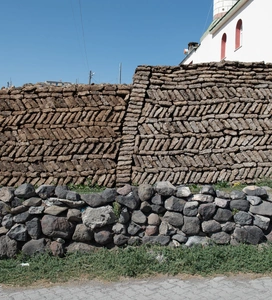
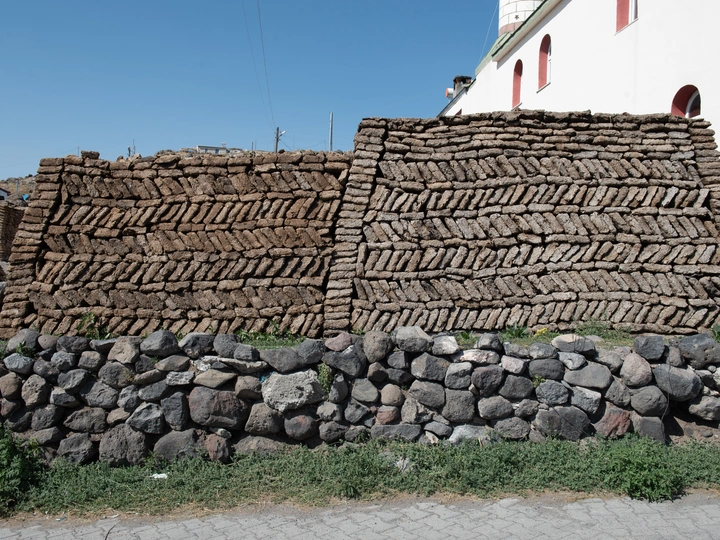
A distinguishing feature of the rural built environment of the South Caucasus is the one-story (historically semi-subterranean) house with a flat earthen roof, inhabited by humans and animals together. Often placed beside these rural dwellings are remarkably constructed, largely by women, heaps of dung bricks, a traditional source of fuel and a construction material made from animal organic waste, specific and integral to rural life in the South Caucasus. For the region’s inhabitants, who predominantly work in animal husbandry, these two architectural units are the product of—and provide the conditions for—coexistence between humans and other species, mediated by historically accumulated indigenous technologies. To present this symbiotic form of life, we imagine the project to consist of a locally produced scale model of a dung heap, photographs of the grass-roof houses, and a video work documenting the production of a dung heap. While this installation introduces a traditional spatial practice from northeastern Turkey, it is part of the historically and demographically diverse region of the South Caucasus, including Georgia, Armenia, and Azerbaijan. Similar practices exist in the rural areas of these countries, and it is the goal of the current research to bring together documentation from other parts of the Caucasus as well. It presents a model of co-existence between the human, animal, and plant worlds; it aims to document a practice disappearing under pressure from incorporation in global capitalism as well as past and present forms of homogenization of demographics, species, and products; and it suggests an approach to sustainability that takes into account the intersectionality of material, design, and heritage. As such, this project tells a story of indigenous living practices through the scene of the intricately constructed dung heap alongside the one-story flat earthen roof house characteristic of the South Caucasus.