Dvoryk: practising urban rights in everyday life
Elena Rabkina
Aliaksandra Rameika
Irina Smirnova
An urban planner with academic education in architecture (in Belarus) and urban planning (Politecnico di Milano in Italy) and informal education and professional training and exchanges in Spain, Germany, Sweden, Lithuania, Estonia, Austria, and the USA. I have ten years of experience working at the intersection of architecture, urban design and urban planning, socio-spatial inequality, public participation, public services accessibility, heritage, tourism, and the multi-scalar production of urban vulnerability in Belarus and Italy.
At the beginning of my career, I worked at private architectural and construction companies in Belarus, and in 2018 I moved to collaborate with the Institute of Urban and Regional Planning, dealing with economic and socio-spatial planning in the whole country. In parallel, I constantly collaborated with local NGOs for urban participation, advocacy, and educational projects and with grassroots initiatives. In 2021, I had to leave my home country due to political persecution for project collaborations with NGOs, so I resided in Milan, Italy. Here I had the opportunity to work at universities as a researcher on topics of housing, safety in the city, climate change, and urban regeneration, collaborate with public institutions (mayor’s offices) and local NGOs, support teaching activities in master’s courses at my alma mater university, develop podcasts on urban studies for the academic and broad public and for Belarusian audience, launch a startup on overtourism, and volunteer for urban festivals and migrant communities.
I speak five languages: Belarusian, Russian, English, Spanish, and Italian, am currently learning Portuguese, and am excited to explore different cultures. I have been learning flamenco dancing and art for 15 years already and enjoy learning other dances around the world. But I am also seeking my own Belarusian identity in this multicultural context.
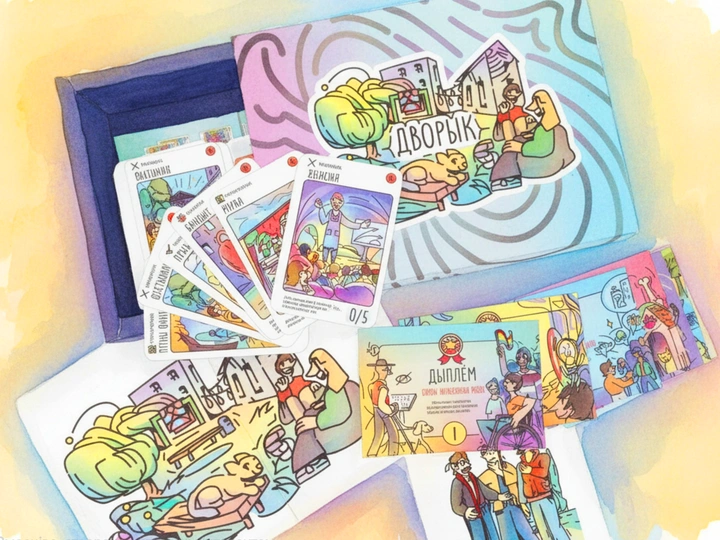
Dvoryk is a participatory urban design and HRBA board game to enjoy rights in the city, developed by a team of Belarusian activists in migration for displaced due to political persecution Belarusians who have to adapt their lives in the new places of living. The title means “courtyard” in Belarusian: an everyday space where neighbours meet, negotiate shared needs, experience conflicts, practise care, and begin collective transformation
The game invites players to redesign a neighbourhood while discussing human rights, accessibility, inclusion, public participation, and responsibility for common space. Through scenarios, role cards, and spatial choices, participants explore how a bench, playground, tactile paving, Braille signage, greenery, or a safer route can change everyday urban life. Dvoryk explores whose daily rhythms are recognised by the city, who has time/capacity to participate, who is excluded, and how temporary actions can become the first step towards long-term socio-spatial transformation
The project was created as a co-design and educational tool. It responds to the Belarusian context, where public activism, community organising, and participation in urban decision-making are politically restricted. The project has a European dimension. Many Belarusians were forced to leave the country and now live across different European cities. For these communities, migration often creates a temporary and uncertain relationship with place, while the need to understand, use and care for local public spaces remains immediate. Dvoryk responds to this situation by helping politically displaced Belarusians reflect on their rights, participation, responsibility, and space of belonging in their new everyday environments. The game has already been played by Belarusian communities in 15 countries.
The project shows how planning education can cross physical and immaterial borders, turning everyday public spaces into places of belonging, inclusion and democratic practice