Transformation of post-communist housing
I am a Polish architect, a recent graduate from Royal Danish Academy in Copenhagen Denmark (MA) and Bartlett School of Architecture in London (BSc). Throughout my studies I developed a particular interest in effect of the built environment on society and local communities. Engaging with political topics and real-life problems became an important part of growing into an architect. In 2023 I published my first article in RZUT - Polish architectural quarterly magazine, titled "Burn down that Rainbow! Urban space of Warsaw as a contested site of fight between pro- and anti-LGTBQ movements". I explored effects of hate crimes and counter-responses to them on the surfaces of the city. In my projects believe that any design needs to be started with an extensive research and understanding of the palimsestic contexts formed by the history of the place, country, community and a place itself. I am interested in conflicts within communities as well as reception of built architecture in the society that can become a core of transformation projects. I want to design with the existing - I believe that built environment is over-saturated with new-built projects and global change in designing is crucial in face of climate crisis and waste production of the building industry. My thesis project focused on socio-architectural transformation of post-communist housing in Poland was awarded with highest grade and I strive to work further with my ideas with more professionals entangled with the topic.
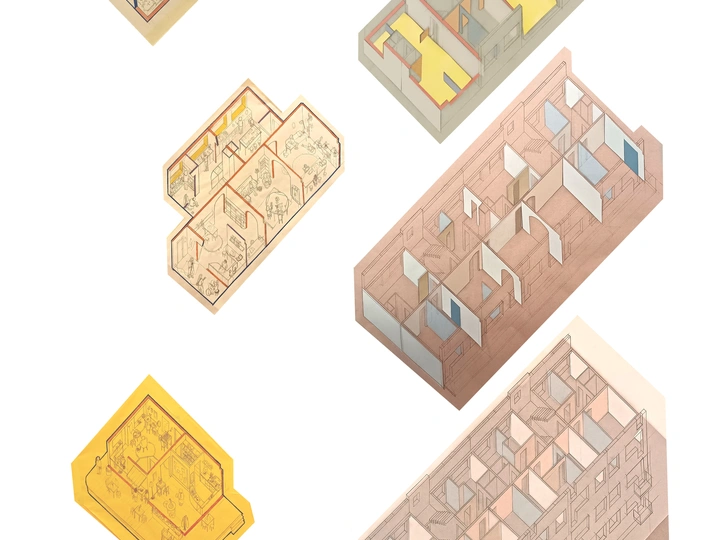
Countries of former Eastern Block, like Eastern Germany, Poland, Lithuania, Latvia, Estonia, Ukraine are largely populated by housing built in the Soviet Era. Grounded in the idea of fast construction and establishing egalitarian societies, repetitive plattenbau (in German)/ bloki (in Polish)/ panelaki (in Czech) became a major force establishing suburban areas of cities in a growing economy and baby boom of post-war period. Neighbourhoods of same typologies become bedrooms of the cities hosting nuclear families. Their design - both in terms of flats, as well as abundant in education facilities and playgrounds urban spaces was intended for that time, however nowadays grows outdated for the aging societies and rigorous rental market. Societal perception of those neighbourhoods is often negative. Communist neighbourhoods hold trauma of difficult times of the regime. Project provides an extension to former manuals provided for communist housing typologies. It builds up technological proposals and focuses on future direction of transformations: analysis and adaptation to the societal perception, expanding on social programmes, addressing aging demographics and housing crisis. Understanding palimsestic reality of the post-communist neighbourhoods becomes a direction of change. Empty flats can become shared spaces where inter-generational knowledge-sharing happens - knitting workshops, social kitchen, music rooms, rooftop gardens. Flats can be rearranged - non-loadbearing walls removed, connecting two typologies of flats and creating more spacious rooms and flats allowing some of the flats to be inter-connected changing buildings flow and welcoming a variety of forms of living. Legally in Poland, housing associations manage post-communist neighbourhoods. Expanding agency of residents over legally shared spaces like by-block gardens can grow their agency over space they inhabit and share, forming stronger community built over cultural commons, not forced from above.