Hair, Space, and the Architecture of Grief
I'm Karla Quiñonez León, a hair sculptor, makeup artist, and founder of La Cultur4, a platform celebrating Latinx creativity. My background moves between Ecuador and Belgium, and I currently live and work in London, where my practice is rooted in hair as a living material something I use to build spatial works exploring memory, migration, and ancestry. I was the first Ecuadorian ever nominated for the British Fashion Awards, named a British Fashion Council Top 50 New Wave Creative (2024), nominated for the 2025 Latin American Fashion Awards, and invited to Cannes Lions by the organisation itself.
Through La Cultur4, in partnership with Firepit Art Gallery & Studios CIC in Greenwich, I produce free workshops, exhibitions, and an ongoing artist residency for Latin American and diaspora creatives, reaching over 400 people in the past year. Everything I make grows directly out of this community work I'm interested in art that stays close to the people it represents, rather than existing at a distance from them.
My practice begins from the body and from hair as a living material something shaped by care, migration, and cultural memory. Each piece I make is my own way of connecting with my ancestors: with every braid, sculpted comb, or constructed altar, I feel closer to a lineage of women who used exactly these materials to carry identity across displacement.
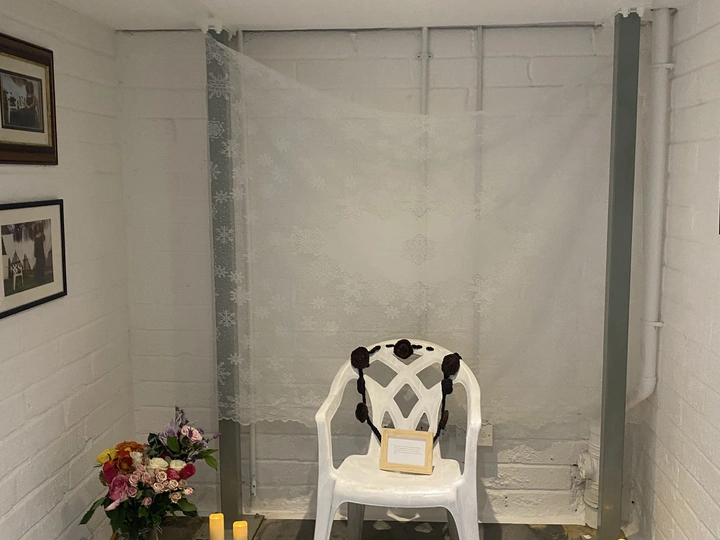
The work started with The Altar (2024), a chair transformed with wire and hair into a space for mourning built because my community could not physically bury those who died far from home. It became less an object than a small architecture of grief: curtains, candles, and a framed portrait arranged around it, creating a room within a room where absence could be held. This was followed by a hair sculpture for the exhibition Para Ecuador, Con Amor, again using an old chair, hair, and wire, extending this same architecture into a meditation on inherited grief and womanhood.
Most recently, I've been developing clay sculptures of afro combs, made with air-drying clay and natural colours continuing the same enquiry through a new material, asking what is carried, adapted, and rebuilt when people are forced to use only what is around them.
I see this work evolving into larger, immersive spatial installations: rooms built specifically for communities to grieve, remember, and reconnect with ancestry collectively rather than alone, using humble, everyday materials as architecture. I'm interested in how spatial practice can hold what formal architecture often excludes displacement, care, and inherited loss.