Collective Futures for Existing Buildings
CO53 is a New York-based architecture and research practice founded by Sharona Cramer and Yotam Oron. The practice combines architectural commissions with speculative design-research and teaching focused on housing, collective development, participatory design, and the relationships between architecture, ownership, governance, affordability, and public agency.
CO53’s work has received Yale’s Independent Design Research Award and has been presented through the Chicago Architecture Center, the Chicago Architecture Biennial and the UIA World Congress of Architects 2026.
Before founding CO53, both Sharona and Yotam worked in architectural offices on residential, public, educational, and urban projects. They studied at the Bezalel Academy of Art and Design and later completed post-professional Master of Architecture degrees at the Yale School of Architecture. Their combined experience spans architectural practice, urban research, writing, exhibition-making, and education.
Sharona has taught at Yale, the Bezalel Academy of Art and Design, and the Negev School of Architecture. Yotam has taught at Yale and the Bezalel Academy of Art and Design and was selected for the inaugural Princeton | Chicago Architecture Center Fellowship.
Across commissioned and research-based work, CO53 uses drawings and models alongside games, pamphlets, narrative fiction, and participatory formats, moving between professional practice, speculative inquiry, teaching, and public engagement.
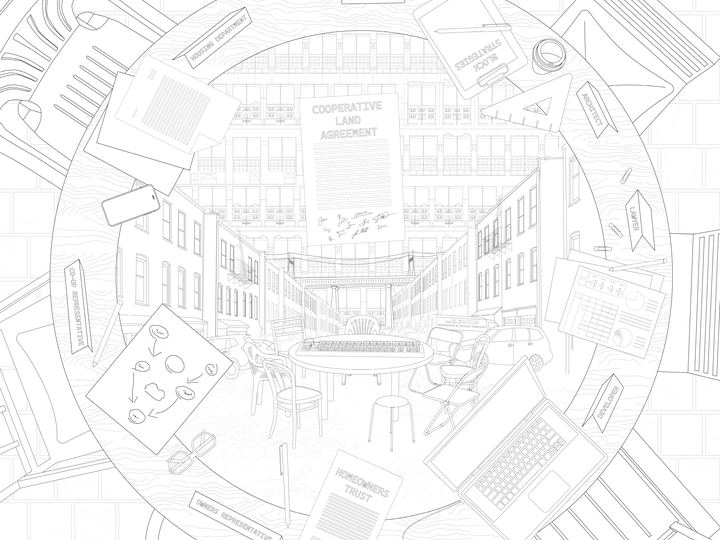
As part of our ongoing research, we explore how urban development can become a collective process. Two previous projects tested this approach in different contexts; Now That the Neighborhood Is Nice, Why Do I Have to Move?, our Yale M.Arch II thesis, proposed a collective development framework for a gentrifying block in Queens, New York. It explored how residents could pool land, negotiate with developers and the city, and shape neighborhood change to reduce displacement while prioritizing affordability and stability. The research was presented at the UIA World Congress of Architects 2026 in Barcelona.
This Is Not a Shelter: Vacancy, Arrival, and Housing in Chicago, developed through the Princeton | Chicago Architecture Center Fellowship, shifted to municipally owned vacant land. It proposes an interplay between the city and a resident collective to develop incremental, lightweight housing and civic infrastructure for long-term residents and new arrivals. It was exhibited at the Chicago Architecture Center in Here to Stay: Architecture After Arrival.
Through LINA, we hope to propose a third collective development model, grounded in a context identified with a member. We are particularly interested in adapting existing concrete buildings to create affordable housing while retaining embodied resources and limiting demolition. As more cities rely on private development for housing, the project asks how private investment can be collectively negotiated and harnessed to benefit existing communities, limit gentrification, prevent displacement, and create affordable homes. It will explore how additions, public incentives, ownership and risk can fund improvements, protect residents, and secure long-term affordability.
Building on our board games, flexible plans, narrative fiction, and pamphlets, we will develop a planning tool that translates relationships between space, ownership, regulation, and finance into formats communities can understand, test, and reshape.