From Exception to Convention
Patricio Sota
Nick C Ulrich
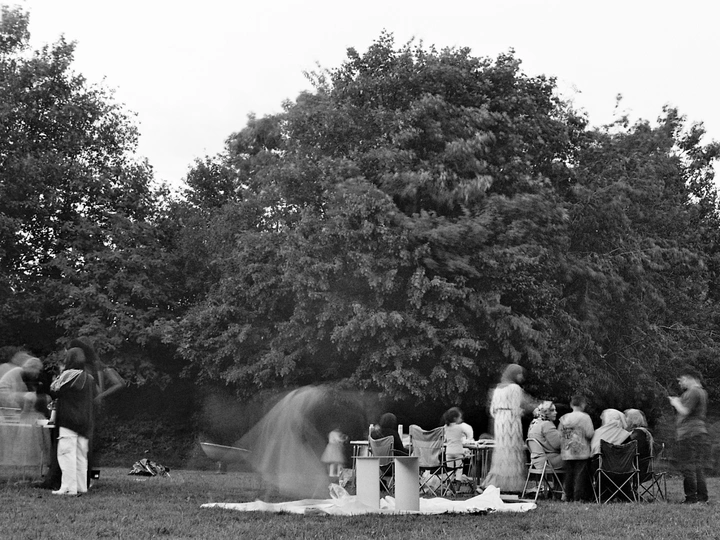
promeNOODology is an association based in Lausanne. We build walking kitchens in public space, because cooking together is one of the simplest ways to meet the people who share a place. We work from the principle that the people who use a space are its real experts.
A core team of three — landscape architect Nick Ulrich, architect Gabriel Ogbonna and artist Patricio Sota — develops and coordinates each project, but the work belongs to everyone who shows up. Each project invites 10 to 20 people to build, cook and run it with us, and more than a hundred people have contributed since 2022.
We formed at EASA, the European Architecture Students Assembly, and have tutored workshops in Călărași, Romania (2022), Sheffield, UK (2023) and Benidorm, Spain (2024), alongside cooking in public space in Austria and Switzerland. Nothing is prefabricated: each kitchen is designed on site from what a place already has or throws away, so no two are alike, and the real skill is learning to see worth where others see waste — lightweight furniture carried through a city, a kitchen built with local growers, an ice cream machine welded from two scrapyard gas bottles. Budgets stay around €700.
We are interested in the difference between a city that is managed for us and a city we care for ourselves. Cities are largely built to be consumed; caring for shared space takes energy, and we look for ways to make that easier and more enjoyable to begin.
Since 2025 we have been working on réalité n°5223, a year-long project on a plot in Versoix left empty by years of contested building plans, curated by least and supported by the Ville de Versoix. Together with neighbours and four members of FSA Genève, who bring a sensory expertise developed through living with visual impairment, we read the site through smell and grow local engagement through temporary events.
We are always looking for people, places and partners to cook with.
In cities, consumption is the convention and care is the exception. Streets and leftover ground are maintained by someone else, so we pass through owing nothing. Caring for shared space costs energy and exposes you — few will pay that price.
promeNOODology works on lowering it. We build walking kitchens in public space because cooking together makes engagement accessible: familiar, endlessly adaptable, ending in something everyone understands — a dish. Enjoyment is not decoration; it is what makes participation affordable.
We arrive with almost nothing. Each kitchen is designed on site from what a place has or discards, so no two are alike. The work is learning to see worth where others see waste. In Benidorm we welded two scrapyard gas bottles into a freezing cylinder, added parabolic stoves donated by a solar-cooking community, and pressed surplus hotel and market fruit into juice. Elsewhere: lightweight furniture carried and rearranged daily (Călărași), a kitchen built with local growers (Sheffield), a distillation laboratory of household utensils (Versoix).
What works is the speed. At 40°C in Benidorm you could not buy the ice cream, only help make it, and strangers joined within minutes. The failures taught us more: evicted from a park in Călărași, we learned that cooking in public is a confrontation over unequal rights to use space.
Our current project reads a contested former estate through smell, with residents and four visually impaired collaborators working as experts of the everyday, building temporary events that grow caring attention among neighbours.
The recurring limit is our own format: we make exceptions, then leave. We now want to study how an exception becomes a convention — documenting not the kitchens but the method: recipes, which by definition adapt to whatever a place provides, and can be followed without us.