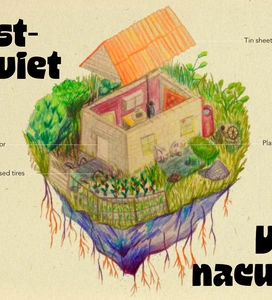
Post-Soviet Vernacular
Katrovasová is an architect, researcher, and journalist based in Prague whose work explores the relationship between the built environment, cultural memory, and ecological transformation. Working across research, critical writing, exhibitions, and public programming, she investigates how the built environment influences and reflects broader political, social, and environmental processes, with a particular focus on Central and Eastern Europe.
Ella has a background in art, with solo exhibitions debuted at the Divo Institute in Beja, Portugal and Recompose Gallery in Prague. She currently studies Architecture at the Academy of Arts, Architecture and Design in Prague (UMPRUM) in the Future Architectures Platform Studio. Alongside her studies, she has participated in the Goethe-Institut's Young Journalist Programme, publishes for JÁDU Journal, and works with the Centre for Environmental and Technology Ethics in Prague, where she contributes to conferences and public discussions. Since 2024, she has studied Ukrainian and volunteered with the Repair Together collective, rebuilding homes destroyed by Russia's invasion of Ukraine.
Her practice spans architectural research, journalism, photography, exhibitions, and speculative design. Recent work investigates the architecture of play, folk magic in the Anthropocene, urban rituals, material cultures, and more-than-human ecologies through essays, installations, public interventions, and collaborative research.
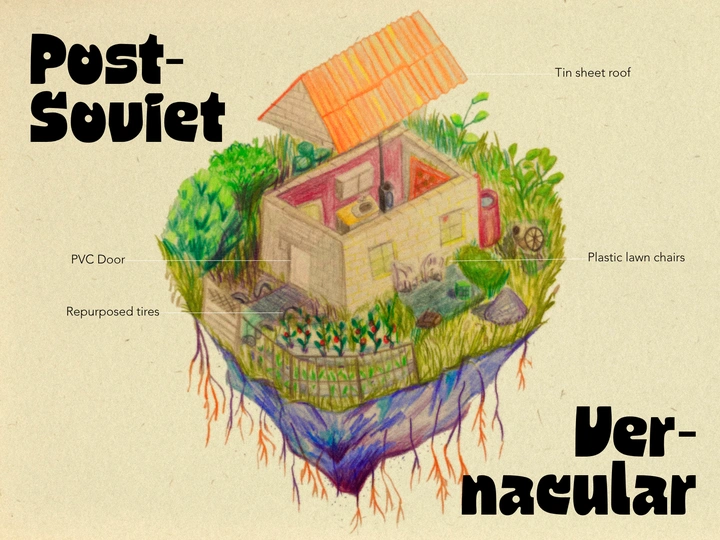
An interdisciplinary research project under the supervision of Eva Franch i Gillabert, the work seeks to document, analyze, and develop discourse around the self-built homes of the Post-Soviet transition period in Ukraine, Georgia, and Kazakhstan. As these nations gained independence from the Soviet Union, they found themselves emerging from an aggressive force of modernization, a common side effect of which –a disconnection from one’s culture and natural landscape– was heightened by Russian imperialist assimilation tactics. The following era of deregulation, economic instability, and ongoing extractivist practices invited in the production of these buildings.
Through theoretical essays, interviews, photographs, field notes, discussions with experts, and architectural illustrations, the work analyzes what these homes can teach us about embodied cultural memory and the understudied re-materialization of folk buildings in the landscapes of the Anthropocene, subverting the notion that modernity fundamentally severed humanity from its cultural and ecological roots. As man-made materials have irreversibly infiltrated global ecosystems, we can no longer define the vernacular in opposition to the modern. Vernacular architecture is where the inseparability of cultural and ecological processes becomes materially visible. As the bird builds its nest from electrical wiring, so too does the vernacular architect construct her home from the materials of her increasingly artificial environment.
Collaborations for the project have already been developed with the Lviv Institute for Urban History, Ubani - Tbilisi Cityscape Research Center, and CESCAME in Prague with contributions from T. Gurgenidze, K. Malaia, and A. Miljački. Sources are currently being gathered for foundational theoretical essays with field research as the next step. While originally proposed as a publication, the project has expanded to multiple potential formats including discussion panels and exhibitions.