Eco-Fiction Labs: Worlding Shared Futures
I am an architect, researcher, and educator working at the intersection of design, contemporary art, environmental humanities, and political ecology. I am currently a doctoral researcher and educator at UCLA’s Department of Architecture and Urban Design, having previously taught design, history, and theory courses at Columbia University, Barnard College, and NJIT. I hold an M.S. in Critical, Curatorial, and Conceptual Practices in Architecture (CCCP) from Columbia and an M.Arch from ETSAM (UPM), where I graduated Summa Cum Laude. I am also the co-founder of Estudio Latente and Latent Ecologies, a design and research practice utilizing critical cartography and speculative fiction to foster territorial ecological resurgence.
My practice operates across a variety of media—including publications, exhibitions, pedagogy, audiovisual installations, and public space interventions. I understand curatorial and design platforms as vital spaces for exercising collective political imagination. My work focuses on translating complex environmental data, landscape degradation, and climate anxieties into public-facing narratives. I am deeply interested in multi-disciplinary collaborations that activate non-specialist imaginations to address pressing spatial and socio-environmental crises.
My research and design practices have been supported by a Graham Foundation Grant (2023), a Yale University Environmental Humanities Fellowship (2024), and a La Caixa Fellowship. I have been a Curatorial Fellow at Storefront for Art and Architecture (NYC) and an artist-in-residence at Art Omi (NY) and Matadero Madrid’s Mutant Institute for Environmental Narratives. Internationally, I have exhibited my work at Ocean Space (Venice) and Citygroup (NYC). I served as the storytelling coordinator for the EU-funded Bauhaus of the Seas Sails with TBA21, and my architectural collective won the prestigious 2025 TAC! Urban Festival prize for emerging architecture in Spain.
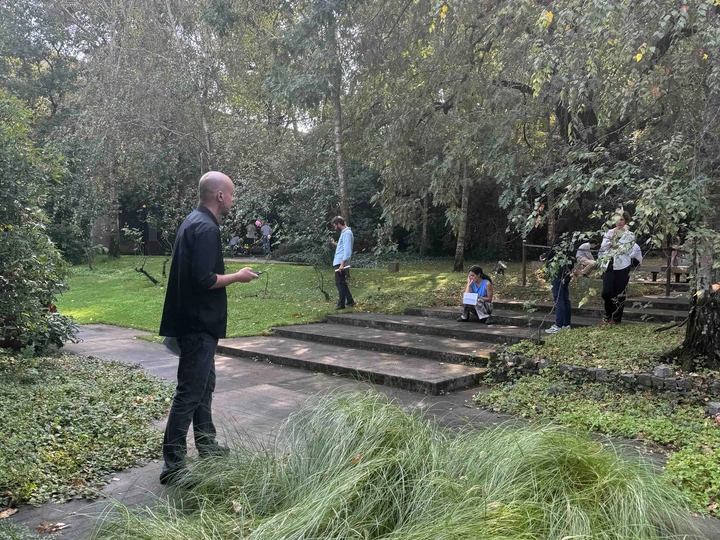
Traditionally, humans use fiction to design the worlds they desire. However, dominant past narratives conflict with our fragile climate reality, often defaulting to catastrophe. Rejecting this defeatism, this project asks: how can we write the fictions we actually need? Guided by feminist fiction writers and their methods for worlding worlds, the project uses fiction to speculate about future contexts, and archeological research to uncover forgotten local practices. We aim to reimagine the complex landscapes of future cities and territories, nurturing relationships between human and non-human agents.I initiated this practice during an art residency at the Mutant Institute for Environmental Narratives (Matadero Madrid), conducting workshops around the Manzanares River. I advanced it as the leading artist for the experiential storytelling project of the Bauhaus of the Seas in collaboration with Thyssen-Bornemisza Art Contemporary (TBA21), and through collaborations with the Brooklyn Public Library. This extended practice easily adapts to short- or long-term engagements across diverse cultures, age groups, and communities.The project invites non-specialist publics—including children—to imagine alternative territorial futures through speculative writing, poetry, sketching, collage, and audio-visual media. It has taken the form of workshops, fictional guided tours, boardgames, screenplay co-writing, and many more. Its most successful aspect across all has been its capacity to activate the collective imagination within situated contexts. Through collaborative play, participants process future conflicts, embrace the "other," and transcend current realities by embodying collective or non-human identities.Future Evolution: Next, I will study local cartographies to anchor new speculative experiments. Tailored to the collaborating partner, the project will culminate in an audiovisual output—such as an exhibition or short films—designed to inspire real-world ecological change.