East of Eden
I was born 1997, Stockholm, I completed my Bachelor's degree in Printmaking (2021) and my Master’s in Painting (2022) at the Faculty of Fine Art in Belgrade, in the class of Prof. Simonida Rajčević. I work primarily in multimedia painting and printing techniques, using mediums such as silk screen printing, industrial printing of various kinds, photo-transfer techniques, oil painting and drawing interventions on canvas and other foundations. Within my art, I explore themes such as intimate social structures, the function of emotional memory in our personal lives as well as in society, multicultural belonging as well as the everyday experience in the age of technological transformation. I have exhibited 14 times independently and over 30 times in group exhibitions, notably at the Museum of Contemporary Art of Vojvodina, the European House in Belgrade, the Graphic Collective in Belgrade, U10 Art Space, the Youth Centre in Belgrade, Cvijeta Zuzoric Pavilion and the Heritage House in Belgrade. I have been published as a think-piece writer numerous times for online platforms including commercial platforms such as RUB.rs, as well as art platforms such as supervizuelna.com. In 2021 I partook in the year long research project into the first avant-garde art magazine in Yugoslavia, Zenith Magazine, for its 100 year jubilee with the Faculty of Fine Art in Belgrade and The Academy of Fine Arts in Zagreb. I also ran the online art and culture magazine Moot.Cloud and am currently a substack writer. I am the project director of Supervizuelna in the Studio, a video-journalistic project exploring the working conditions and environments of artists, predominantly in Serbia. Since 2023 I have co-coordinated the Art Meets Science program for the think-tank Re:people, an annual program exploring the interdisciplinary applications of Art in Science, and vice versa, via innovative international hubs, institutions, companies and civil
societies such as Ars Electronica.
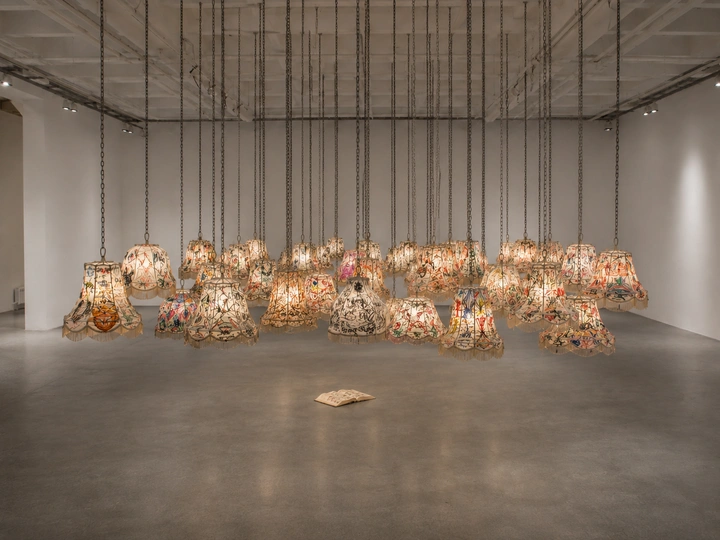
East of Eden is an installation that stages a quiet encounter between viewer, light, and text, inviting a reconsideration of how we approach knowledge, comfort, and proximity in an age shaped by information overload. Suspended from industrial chains, a clustered field of low-hanging lamps evokes systems of mass production and distribution — structures that mirror the mechanisms through which information circulates today. Yet each lampshade, made of hand-sewn organic cotton and marked by individual, gestural drawings, resists uniformity, bearing traces of human presence, inconsistency, and interpretation.
At the centre, a solitary open book rests beneath the light. It is not immediately accessible; to engage with it, the viewer must physically lower themselves, stepping out of passive observation and into a position of attention. This gesture becomes critical: the work proposes that understanding cannot be absorbed at a distance, but requires closeness, care, and a willingness to reorient one’s body and perspective.
The installation responds to a contemporary culture increasingly shaped by fear — fear amplified through the mass circulation and weaponisation of information. In such conditions, knowledge often becomes overwhelming, abstracted, and detached from lived experience. East of Eden counters this by creating a space of slowed perception, where information is encountered not as a stream, but as something situated, intimate, and partial.
Referencing Steinbeck’s notion of moral choice and ambiguity, the work does not promise resolution or clarity. Instead, it offers the conditions for reflection: a space where solace may be sought, but never guaranteed. The viewer is invited to come closer — not to escape the world, but to reconsider their relationship to it, recognising that even the most neutral systems are shaped by human intention, bias, and fragility.