Ex SNIA: Naturecultural Exchanges
Michele Porcelluzzi is an architect and researcher whose work focuses on public space design and collective life. After gaining professional experience in architectural offices in Milan and Berlin, he completed a PhD – jointly conducted at Politecnico di Milano (DAStU) and ETH Zürich (D-ARCH, NEWROPE Chair of Architecture and Urban Transformation). His research was supported by NextGenerationEU and Swiss Government Excellence Scholarship.
His doctoral project, "Urban Spaces for More-than-Human Communities. Collaborative Processes, Design Attitudes and Hybrid Practices", examined five naturecultural places across Europe: Floating University in Berlin, De Ceuvel in Amsterdam, ASIAT Park in Vilvoorde, Krater in Ljubljana and Stadionbrache Hardturm in Zürich. Across more than 250 days of fieldwork, Michele worked from within the everyday life of these sites. He joined local activities and followed ecological change over time. This experience led him to understand design as a process that grows through use and remains open to revision.
Alongside the PhD, Michele developed curatorial projects and worked on exhibition design. He is interested in public formats that make complex spatial questions understandable without simplifying them. His writing has appeared in OASE (2022) and Die Architekt (2023). His work was also exhibited at the International Architecture Biennale Rotterdam in 2022.
From September 2026 to June 2027, he will be a resident fellow at the Istituto Svizzero in Rome. His project will focus on the Ex SNIA area.
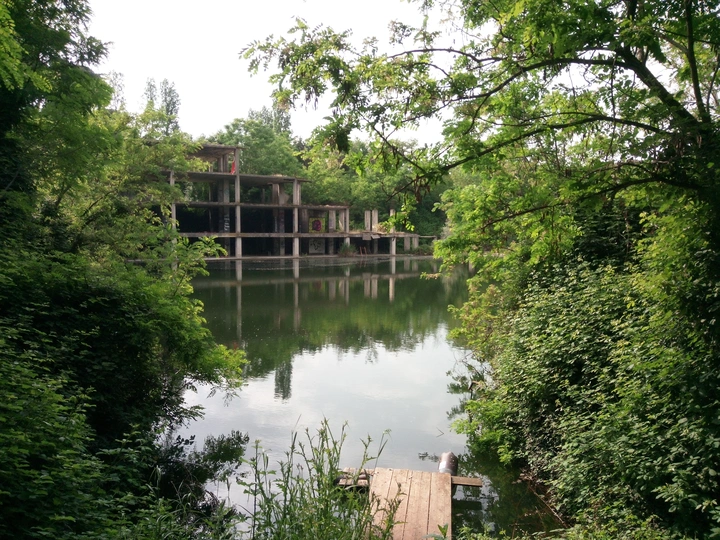
The project begins in the Ex SNIA area, a former industrial site in Rome shaped by an unexpected ecological event and by the people who fought to keep the area public. A lake emerged inside the abandoned factory grounds. Around it, a civic mobilisation grew and changed the meaning of the site. From September 2026 to June 2027, a ten-month residency at the Istituto Svizzero in Rome will make possible to remain close to this place and follow its transformations.
The work will grow from being there. It will take part in the life of the area and learn from those who know it from within. Repeated observation will reveal how the site changes through the seasons and how its future is negotiated through everyday use. The architectural question is how to work with what is already there while allowing the place to remain open.
At ex SNIA, public space is not defined by access alone. It has been produced through encounters that became connections and through connections that formed a network. This network gives the place a public meaning and the capacity to resist disappearance. Public space exists here as a relationship before it becomes a design. Conducted in close collaboration with the local community, the project will explore how architectural design can recognise this condition without fixing it in a final form.
The objective of the prohect is to tell this story beyond Rome: this can create new encounters and invite other ways of understanding places whose value is disputed.
LINA can provide the wider field in which the work can circulate and evolve. Its form would be defined through dialogue with each member. It may also connect Ex SNIA with other naturecultural sites in Europe, allowing ideas to circulate between sites without turning any of them into a model.
The residency roots the work in Rome. LINA allows it to enter a European conversation and generate connections.