Fables of Porgress
My name is Helena Escudero (Barcelona, 2000). I am a spatial designer and researcher working at the intersection of territorial research, spatial design and narrative. I investigate how ecological, political and economic systems shape landscapes, making those invisible processes tangible and experienceable.
I understand design not as the outcome of research but as its final stage: research only becomes complete once it is translated into a spatial experience, an installation, an object, or a publication capable of activating knowledge beyond academic contexts.
Methodologically, I move between macro and micro scales, from broad theoretical frameworks in political ecology, urbanism and landscape studies to the concrete realities of specific territories, allowing large-scale dynamics to become legible through local conditions.
This way of working has developed through a series of projects. My undergraduate research, La Arquitectura Pobre del Baix Llobregat, explored informal architectures as expressions of territorial identity and received the Research and Artistic Creation Grant from the Government of Catalonia. I then expanded my practice towards curatorial and spatial design at FLOP, the CCCB's youth thought festival. Collaborating with Raumlabor in Germany reinforced my interest in collaborative and socially engaged practice beyond Spain.
These experiences culminated in my Master's at Design Academy Eindhoven, where I graduated Cum Laude with Fables of Progress, a territorial research project investigating Barcelona's infrastructural landscape through a dialogue between hydraulic engineering and gym culture, to be presented at Dutch Design Week 2026.
Today, my practice continues to explore how design can translate territorial complexity into embodied experience and how narrative can become a design methodology. I am interested in institutions that understand design as a cultural tool for generating new ways of reading, discussing, and transforming territory.
Fables of Progress analyses Barcelona’s urban expansion model through the case of the Pla Delta, a large-scale planning project that radically transformed the Llobregat Delta by diverting the river two kilometres from its original course to enable airport and port expansion and the construction of large infrastructure networks. The result is a landscape where ecological value and heavy infrastructure permanently overlap.
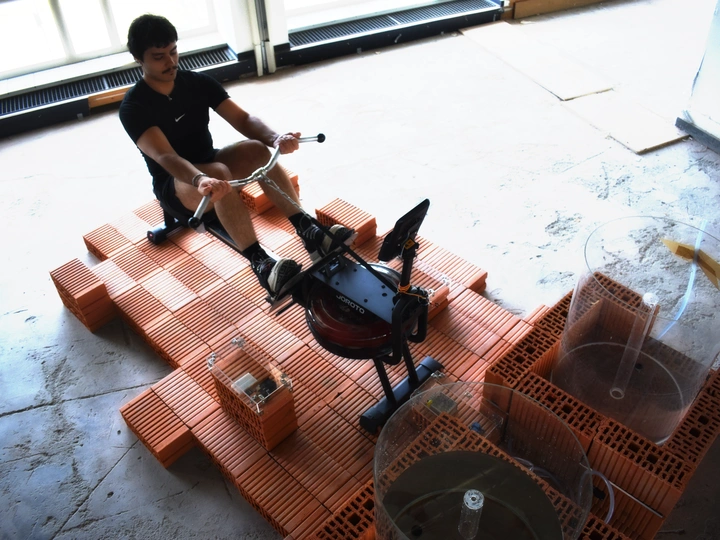
The project connects this research with a second field of investigation: gym culture. Rather than approaching the Delta only as an urban planning issue, it explores a broader logic of optimisation, expansion and accumulation that acts on both landscapes and bodies. Gym machines optimise the body by regulating and amplifying effort; hydraulic infrastructures do the same with the territory by channelling, regulating and transforming ecosystems into economic engines.
The design proposal focuses on a specific ecological conflict: the loss of the river’s natural force. Without intervention, seawater penetrates the Delta and threatens its freshwater aquifer. To prevent this, an underground hydraulic system injects treated water into the river. The Llobregat has become an “orthopaedic river”, a river that requires permanent technological support to survive.
This conflict raises a series of design questions: Can movement and the body become tools for understanding landscapes? Can the Llobregat Delta be experienced through physical action rather than maps and data? Can gym objects and machines acquire new meanings? The project responds through an interactive rowing machine that allows visitors to experience the forces sustaining the river. Movement becomes a way of reading the landscape.