Endosymbiotic Diagrams: Symbiosis as Method
Since early 2025, I have been developing a new independent research practice at the intersection of architecture, art and critical theory. This new field of work builds on—but is distinct from—more than two decades of professional architectural practice, including leading competition teams at MiAS Architects.
My education spans architecture at ETSAB and ENSA Paris-La Villette, art history and theory at Université Paris 1 Panthéon-Sorbonne, and fine arts at the University of Barcelona and Central Saint Martins. This interdisciplinary background informs my current research, which is grounded in relational and systemic thinking.
The central project of this emerging practice is the Symbiocene Architecture Project, a research platform I have been developing over the past eighteen months. It explores how systems of thought, language, diagrams and form can become mechanisms of evolutionary change in architecture. Through drawing, writing and speculative visual practices, I construct environments in which heterogeneous forms of knowledge can interact and generate new architectural possibilities.
Architecture’s response to the climate crisis remains largely technical: materials are substituted, performance is optimised, and “sustainability” is added without changing the underlying logic. Endosymbiotic Diagrams asks whether architecture can evolve by transforming the systems of thought that generate it.
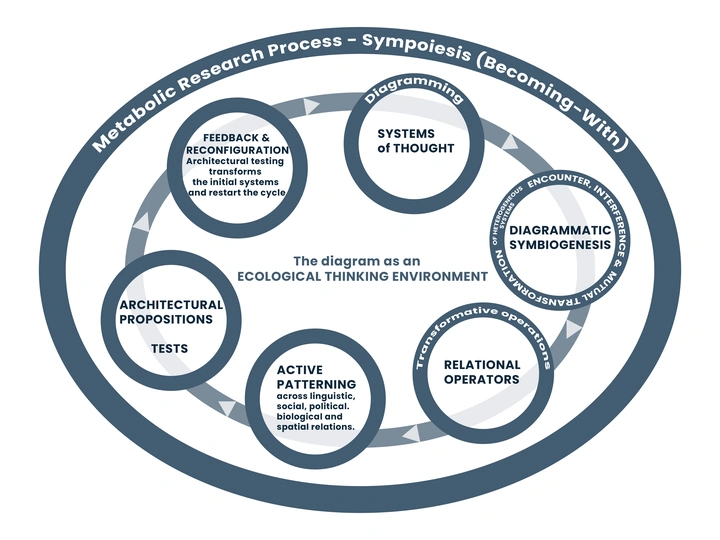
The project tests symbiosis not as a theme, but as a method. It develops an evolving diagram by bringing heterogeneous knowledge systems into contact—including Lynn Margulis’s theory of endosymbiosis, Bayesian inference and Richard Dawkins’ extended phenotype. Without translating them into architecture or reducing them to a common model, it compares their relational structures, allowing them to coexist, interfere and modify one another.
The method has four operations:
1. Diagram each system abstractly: its entities, relations, boundaries, feedback loops, agency and mechanisms of change.
2. Overlap the diagrams without resolving their contradictions.
3. Detect recurring relational operators, such as distributed agency, recursive updating, porous boundaries and evolution through sustained interaction.
4. Test them through writing, spatial prompts, workshops and visual reconfigurations.
The diagram is not an illustration of knowledge, but a thinking environment in which new relations can emerge. Form is understood not as an object’s appearance, but as the active patterning of linguistic, social, political, biological and spatial relations. The project asks whether these operators can generate an architectural language before hardening into fixed forms or design solutions.
The outputs are an evolving diagram, a short thinking protocol and a public format adaptable across contexts: an installation or workshop, an editorial atlas or essay, or a mentored research process. The aim is not another version of sustainable architecture, but a tool through which architecture can begin to think—and therefore form—differently.