The Art of Survival
Ravenna Westerhout is a Dutch-Hungarian architect, researcher and curator whose interdisciplinary practice uses architecture, art and culture as tools to investigate urgent societal challenges. Her work examines the spatial dimensions of war, displacement, collective memory, identity, feminism, decolonisation and social justice. Her practice is driven by the belief that architecture is not only a physical environment, but also a cultural and political practice.
Through research-driven, collaborative and site-responsive projects, she seeks to foster social change by creating new connections between people, places and the stories that shape them. Working across documentary film, cross-media practices, exhibitions, publications and public programmes, she combines architectural thinking with narrative methods to foreground overlooked histories and perspectives.
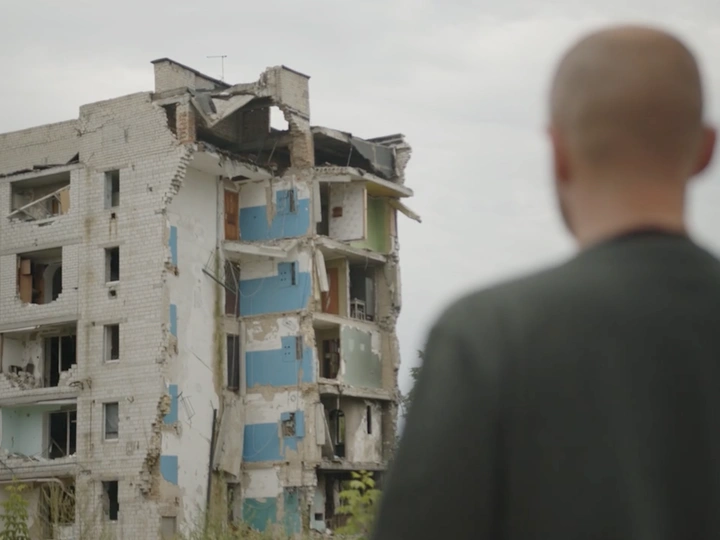
Her current ongoing research project, The Art of Survival, focusses on the war in Ukraine as a lens to investigate the role of architecture, art and culture in times of war. Building on earlier research into the siege of Sarajevo, it explores how creative practice helps preserve memory, identity and humanity in times of conflict.
Ravenna graduated cum laude in Architecture from Delft University of Technology (2018). She subsequently completed the post-master programmes Decolonizing Architecture Advanced Studies at the Royal Institute of Art in Stockholm (2024) and the Berlage Center for Advanced Studies in Architecture and Urban Design in Delft (2026). She has contributed to exhibitions, publications and public programmes, including the Amsterdam Museum, and currently serves as Curatorial and Programme Lead of the inaugural edition of Open House Amsterdam.
“Art is our gun” says curator Lyana Mytsko. As with any war, there is mostly attention for death and destruction. Nonetheless, war is also a matter of life and creation. With spirit and creativity, the Ukrainian people prove they can stand up against a seemingly more powerful army. Architecture, art and culture are essential for their survival, as it helps to feel human, even under the most miserable circumstances.
War itself cannot be considered directly a creative force. However, the tragic external forces on a besieged city stimulate a specific human reaction that leads to the creation of new spaces and new ways of living. The Art of Survival is a multifaceted study through film, documenting the role of architecture and art in times of war. Media, and especially film, shape how we perceive our environment. Media create an urban consciousness: they provide images of cities that are primarily mental constructions rather than real places. Instead of following the scenes of carnage that leading media so often show, this study follows the alternative scenes. As opposed to ‘normal’ circumstances, in disaster, urban changes are rapid, unpredictable, and difficult to control. Architects and artists are operating in an imagined and ever-changing world and their role changes. Throughout this research, I identify different levels of the role of engagements: 1. Army first: artist become soldiers, or use skills to support army; 2. Heritage and culture preservation, self-chosen methods of documentation; 3. Art as a weapon: fighting propaganda; 4. Ways of coping: (collective) healing; 5. Building a future: creation from destruction.
My aim is that through cinematic narrative and use of film as a research method, I open up possibilities for a new reading of the role of architecture and art in times of war, beyond the existing interpretation, a new understanding of how the seemingly simple fact of carrying on, despite everything, is a powerful act of resistance in itself.