New Public Atmospheres
Felix Steinbacher
COAT is a vienna-based architectural studio at the intersection between architecture, spatial installation and design, founded by Julia Fraolini (FRA) and Felix Steinbacher (GER). The practice's focus lies in investigating architecture's potential in shaping socio-cultural, ecological and collective experiences through experimental re-interpretation, transformation and intensification of pre-existing and archetypal conditions.
Their work merges conceptual contemplation, analytical research and hands-on, prototypical design; rooted in a fundamentally contextual approach, each project’s site is positioned as a spatial, atmospheric resource, whose intrinsic potentials and qualities are intensified. Through experimental and atmospheric spatial design approaches, novel and alternative conditions emerge, infusing the familiar existing with new and unforeseen qualities.
Through their projects, spatial and architectural narratives are re-defined and conventional ways of thinking are challenged. Both individuals and collectives are encouraged to re-evaluate habits, ways of living, and their relationship to the shared environment.
Particular emphasis lies in 1:1 prototyping through constructive and material experimentation infused with craftsmanship and low-tech methods. This hands-on approach, blending modularity, ready-made and non-standard applications, ensures circularity and ecological sustainability. The conceptual integration of adaptive re-use strategies in the preliminary design phase furthermore increases the lifespan of projects.
The project emerges from a close reading of existing conditions: heat situations, existing infrastructure, underused spaces, historical settings. Rather than treating these conditions as constraints, it understands them as latent resources from which new spatial possibilities can emerge.
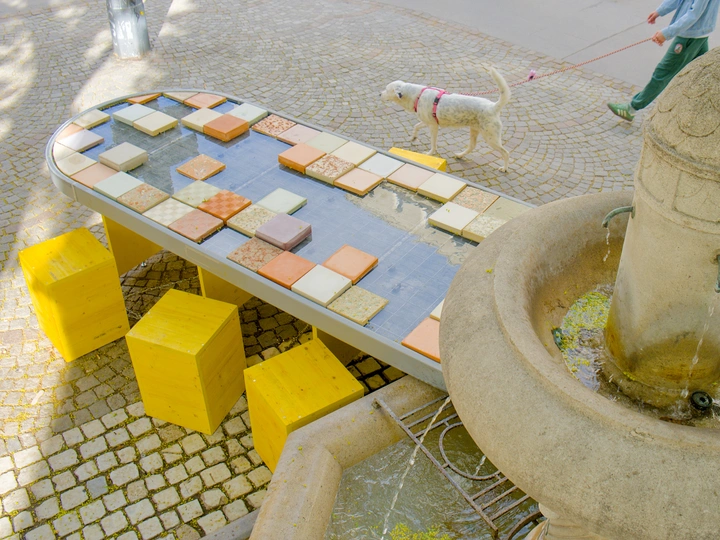
In Vienna, this approach was explored around a historical fountain, revealing the potential of existing infrastructure to support new forms of public life and ecological thinking. The fountain’s adiabatic cooling potential was enhanced by a table hovering above it as an add-on basin, expanding its water surface. Additionally, bringing people into closer contact with water, it acts as both a climatic and social catalyst.
The added basin to the historical fountain, designed as a water trough for dogs, horses and birds, highlights new conditions for urban interspecies cohabitation.
The project treats the process of making as spatial research. Developing craftsmanship and low-tech solutions to ensure an ecological approach, non-standard applications and a call for self-action. A free workshop transmitted open-source craft-based methods. Participants learned sand-casting methods and produced cement tiles integrated into the table, enabling their political agency and democratic participation in the architectural production of public space.
Sand-casting allows an individual expression of each participant’s tile by sculpting the sand placed into the reusable wooden formwork. Once the cement has cured, the sand is brushed away, dried, and reused for subsequent castings.
The installation acts as an urban ecological prototype integrating participation, circularity and adaptability from the start. Temporariness becomes an opportunity to continue the design process: test, adapt and generate new possibilities in direct dialogue with changing communities and contexts. In this case, the table is relocated and transformed into a barrier-free planting table in a communal cultural space.