The Mineral Network
Giacomo Gallo
Remco van der Togt
We are composed of 4 people working within 3 brands.
Im Robert Younger, an urban designer and partner at NEW ENVIRONMENTS, specializing in innovative strategies and scenario planning to harmonize human-environment relationships. As Head of Urban Design at Fontys Academy of the Arts, I curated a curriculum focused on Degrowth and Urban Futures while expanding the school’s international professional network. These days Im teaching the Master students at the Design Academy in Amsterdam.
Giacomo is an architect and urban designer, founder of NEW ENVIRONMENTS. He works internationally on urban assignments connecting different disciplines and scales. Climate-positive design and wellbeing act as core pillars for his projects.
Giacomo is committed to education: the driving force for critical thinking and activism. He is a design critic and guest lecturer at several higher education institutions, such as the Amsterdam and Rotterdam Academies of Architecture, where he pursues learning through urban practice.
He gained experience at UNStudio, KCAP, and MUST, working on complex international and Dutch urban design projects involving multiple stakeholders. In Porto he founded the start-up for temporary urban projects CITY.MAKING. His graduation project was distinguished at Archiprix Portugal.
BREM landschap was founded by landscape architect Remco van der Togt. BREM works across all scales—from courtyards to regions—designing smart systems, attractive landscapes, and engaging places in close collaboration with diverse disciplines.
Remco previously worked at Strootman, won the national Archiprix, and served as Young Innovator for the Board of Government Advisors. He has taught at the Amsterdam Academy of Architecture, Wageningen University, Fontys, and lectured in Delft and Milan.
Other Spheres
a design office for resilient buildings and landscapes that can evolve together, Karlijn is also busy with a start-up producing glitter from algae.
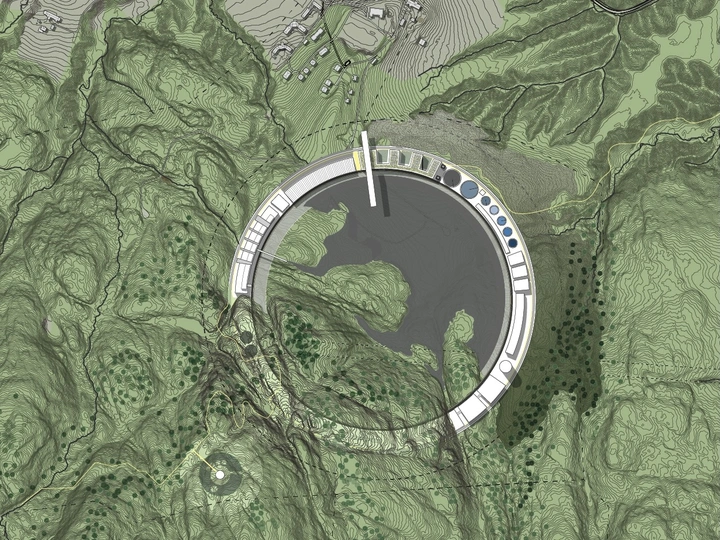
"Regenerative mining" sounds like a paradox. Throughout human history, resource extraction has been inherently linked to the destruction of ecosystems and human rights violations—turning landscapes into sacrifice zones defined by labor exploitation, forced displacement, and degraded soil, water, and biomes. Today, the global race for rare earth elements driving the AI revolution intensifies this crisis by exploiting vulnerable communities and ecosystems. Post-mining programs are typically carried out haphazardly, failing to heal the territorial scars left behind. "The Mineral Network," won EUROPAN 18 in Nome, Norway—home to the Fen complex, Europe’s largest rare earth deposit—by proposing an integral regeneration strategy before extraction starts. By shifting the perspective from a mine as an isolated pit to a regional network of ecological, social, and energetic flows, we made its massive territorial legacy evident. The project’s key success lay in reframing the narrative: positioning the local community and non-human actors not as passive victims, but as primary stakeholders who retain local spatial and economic value. This approach generated immediate impact, reframing local political debate around the mine’s long-term legacy and stakeholder agency. Core objective is to make the spatial implications of extraction transparent, retain value locally, and hold operators accountable. Being involved pre-extraction allows us to shift from reactive mitigation to proactive regeneration strategy.
We focus on mapping a metabolic framework across the mine's full lifecycle: from probing and excavation to operation and post-closure. By mapping resource flows, hydrological impacts, and energy infrastructure, we identify active opportunities for ecological restoration and socio-cultural synergy. Ultimately, this serves as a territorial playbook that integrates spatial development, ecology, rights of nature, and strict environmental governance into extractive practices.