The Landscapes That Protected Us
Kateryna Bulatova
Our collective brings together Daria Borovyk, an architect, urban planner, and evacuation medic, and Kateryna Bulatova, an architect and designer. Together, we explore how landscapes shaped by conflict can evolve from infrastructures of survival into infrastructures of care.
Our collaboration began through conversations and a shared curiosity about how architecture can remain relevant in times of crisis. Having worked together on participatory research and co-design processes, we believe meaningful design starts with observation, dialogue, and lived experience.
Alongside her architectural practice, Daria serves as a volunteer evacuation medic in Ukraine. Working in conflict landscapes has fundamentally reshaped her understanding of architecture, revealing the relationships between survival, infrastructure, and nature.
Kateryna complements this perspective by transforming complex research into intuitive and visually compelling design. Her approach is driven by the belief that architecture should make complexity accessible through human-centred design, where clarity, careful attention to detail, and thoughtful representation invite people to engage, discover, and connect with ideas. For her, good design reveals itself gradually — its character lives in the small details, turning the experience of a space into a journey of discovery.
Together, we combine architectural research, storytelling, mapping, graphic narratives, and prototyping to develop projects that connect ecological regeneration, spatial design, and post-conflict recovery.
Some of the most important architecture I encounter was never designed to be remembered.
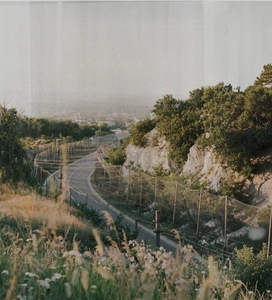
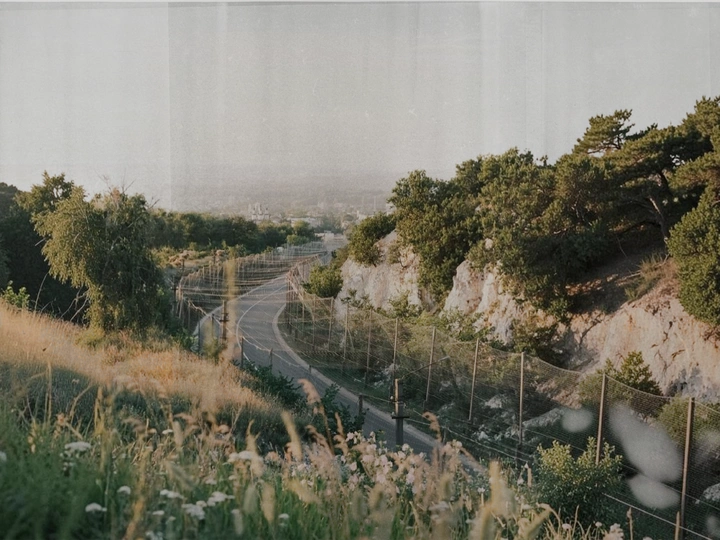
As an evacuation medic in Ukraine, I spend much of my time beneath anti-drone nets stretched across roads, villages, and fields. They were never meant to stay, yet they have become one of the most important pieces of architecture we rely on to return home alive.
I was trained as an architect long before I became a medic. During an evacuation, there is no room to think about architecture. Every decision is reduced to survival.
It is only afterwards, on the drive back, that another way of seeing slowly returns. As the urgency fades, I catch myself looking upward. The first thing I notice is rarely the net itself, but everything that has already begun to inhabit it: rainwater caught in the mesh, birds weaving nests, vines searching for another surface to climb.
Nature never asks whether a place was meant for life. It simply begins.
Working in these landscapes has changed how I think about architecture. We often speak about protecting nature, yet again and again it is nature that protects us.
The project began after I shared these observations with a friend—also an architect. We spoke about the paradox of these structures: designed to protect life during war, yet destined to become waste once they are no longer needed. As our conversation unfolded, the question gradually became an idea.
Rather than treating anti-drone nets as temporary infrastructure waiting to be dismantled, we began imagining them as living infrastructures—harvesting rainwater, supporting phytoremediation, and creating habitats for plants, insects, and birds.
This is not an attempt to romanticise the infrastructure of war, nor to suggest it should become permanent. It is an invitation to rethink reconstruction—not as an act of removal, but as a process of observation, transformation, and care.
If nature has quietly helped us survive the war, how can architecture help return that care?