Pietre de Hotar
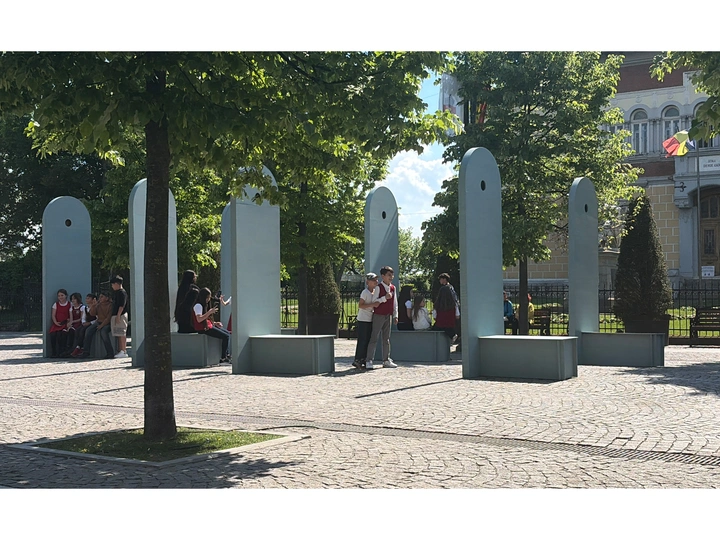
One quality that defines me as a practitioner is my eagerness to embrace every opportunity to learn, collaborate, and experiment. Much of my architectural education has been shaped not only by university, but also by exchanges, summer schools, workshops, conferences, and Erasmus experiences, both nationally and internationally. These experiences have been fundamental in broadening my perspective through meaningful exchanges with people from diverse cultural and disciplinary backgrounds.
My time in Berlin and Madrid, in particular, profoundly influenced the way I think about collaboration, interdisciplinarity, and architectural practice. Together with the workshops and summer schools I attended, these experiences encouraged me to remain curious and creatively engaged with fields extending beyond architecture itself.
I strongly believe that, to create meaningful architecture, one must constantly look beyond the discipline.
So far, this approach has culminated in two competition-winning projects that were subsequently realized. The first was an installation for the Beta – Timișoara Architecture Biennial, where I translated the curatorial theme In Practice – As Opposed to in Theory into a visually striking spatial experience that explored the tension between these two conditions. The second was an architectural installation for Romanian Creative Week in Iași, where I proposed the present project as an interactive intervention that invites people to become active participants in the work itself.
Each of these experiences has reinforced my belief that architecture extends far beyond the production of buildings. They have taught me to adapt, collaborate, and continuously challenge my own assumptions. As I continue to build my professional path, I am eager to embrace new opportunities, contribute to meaningful projects, and keep learning through practice.
Some places in the city are well known and used, while the majority are overlooked. Among the latter, there is a lot of hidden potential for these spaces to become alive; they would only need a "signal" to point this potential out. Guided by this idea, the project began with the intention of creating an object capable of finding its place wherever it is positioned, one that, through its mere presence, reveals the hidden potential of the space it inhabits.
Just as we gain strength and confidence when we come together, the proposed object likewise finds its full potential when accompanied by others of its kind. Together, "Pietre de Hotar" can define a stage, a place to gather, a space for contemplation, or simply an opportunity to become aware of ourselves in space alongside other people.
Being an inhabitant of a city can often feel overwhelming. We occupy countless spaces and hurriedly pass by even more. We constantly think about what our cities lack, without realizing that perhaps everything we need is already there—we simply have not learned to see it yet. The potential of many places to respond to the needs and desires of their inhabitants is always present, yet often remains hidden in plain sight. Sometimes, all that is needed is a small signal.
The mirror embedded in each object serves as that signal—an invitation to become aware of our own presence within the space we occupy. We are always present, continuously shaping the places we move through, even if we cannot always perceive ourselves within them. The mirror places each of us at the center of attention, transforming us into the protagonists of the space. In this way, the project seeks to turn the simple act of being present into a performative gesture.