Heritage as Territorial Infrastructure
Francesco is a junior architect educated in Naples who currently lives in Spain, where he works in an architectural practice while maintaining professional links with Italy. Isabella also studied Architecture in Naples, where we shared much of our academic journey, developing a common design approach and supporting each other's growth. She now practices in Italy, on the Amalfi Coast. Although working in different contexts, we remain connected by a shared interest in architecture rooted in landscape, cultural heritage, environmental responsibility, and the reinterpretation of local building traditions through a contemporary perspective.
The Phlegraean Fields host one of the Mediterranean's richest archaeological landscapes, yet many of their Greek and Roman sites remain fragmented, poorly connected, and only partially integrated into everyday public life. At the same time, the territory faces growing challenges related to seismic and volcanic risk. Over the past two years, intensified bradyseismic activity has produced daily earthquake swarms, exposing the need for public spaces and infrastructure that can support communities not only in ordinary conditions but also during emergencies.
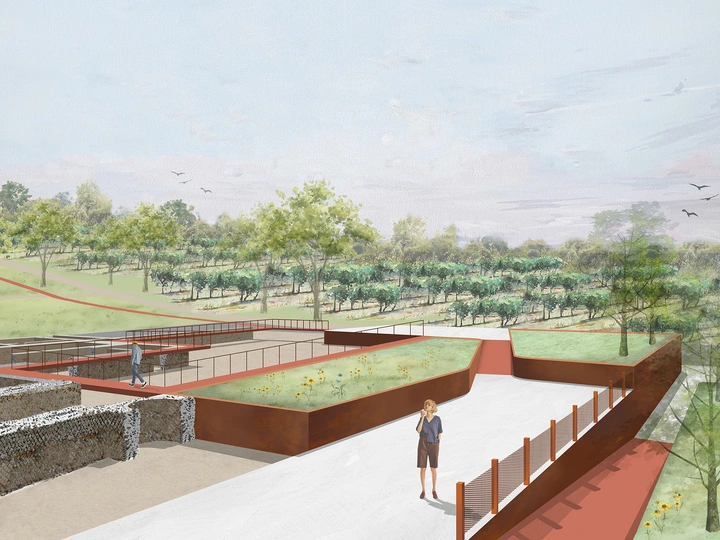
This design research explores how archaeological heritage can become the backbone of a resilient territorial strategy. Rather than treating heritage solely as a cultural resource, the project reinterprets it as an active infrastructure capable of generating social, spatial, and environmental value.
The proposal creates a distributed network of public spaces, pedestrian and cycling routes, landscape connections, and local services linking archaeological sites across the municipality of Bacoli. In everyday life, this network improves accessibility, strengthens local identity, and promotes a more inclusive and sustainable use of the archaeological landscape.
The project therefore proposes a dual-use landscape infrastructure, integrating heritage enhancement and disaster preparedness into a single planning strategy. Rather than creating separate systems for culture and civil protection. The same spaces designed for cultural use are also prepared to operate during emergencies, functioning as gathering areas, temporary shelters, service hubs, and evacuation routes. By integrating heritage enhancement with disaster preparedness, the project transforms the archaeological landscape into a resilient infrastructure that supports both daily life and emergency response.