The Mobile Archive of Invisible Labor
My name is Chinedum Muotto. I am based in Dublin, Ireland. I work across visual art, ecology, and spatial research. I was also a researcher for the African Heritage, Art and Culture Sub-Committee of the UN Decade for People of African Descent.
Over the last several years, I have developed a practice that relies entirely on found materials. I do not buy expensive building supplies. I look at what is already in the street a bike rack, a discarded wooden board, a sidewalk crack and I use it to build temporary structures. These structures do not ask for a permit. They simply arrive.
My interest lies in the architecture of maintenance. I ask: who cleans the buildings that we admire? Who carries the buckets, the mops, and the dirty uniforms out through the service doors? In 2023, I built the "Guerilla Cross" in Paris to respond to a racist incident I witnessed. That piece taught me that a piece of fabric hanging in the wind can carry the weight of a whole testimony.
Now, I want to expand that into a mobile system. I want to show up in different cities, gather the fabrics of the invisible workforce, and let the sun and wind tell their story in public.
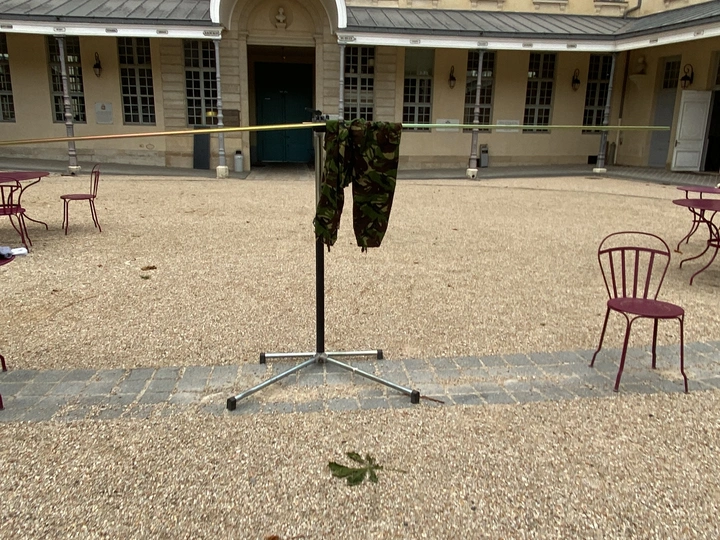
This proposal is the next step after a piece I built in Paris. In the summer of 2023, I hung my own clothes on a makeshift cross in the courtyard of the Centre Culturel Irlandais. That work was a personal reaction to a racist assault I witnessed there. I used the building's own bicycle rack to hold my clothing, placing the sweat of my daily war into that pristine space. It got me thinking about the other bodies that maintain these buildings.
This new proposal moves that method out onto the streets. I will build a simple, mobile drying cart using scrap metal and wood. I call it the Mobile Archive of Invisible Labor. I will push this cart to the back entrances, service doors, and basement stairwells of big cultural and corporate institutions. I will sit with the cleaners, the porters, and the maintenance staff—the people who clean the floors and empty the bins but are told to enter through the side doors.
I will ask them for a single piece of their worn work clothes for just one day. They do not have to tell me their names or their stories unless they want to. Then, I will wheel their garments out to the front entrances and hang them on the line in plain public view.
It is simple. A uniform hanging in the sun. But it forces the public and the institution to look at the fabric that keeps their spaces gleaming.
The project also lives digitally. Each garment will have a small QR code attached. When a passerby scans it, their phone opens an Augmented Reality overlay. If the worker gave their permission, the AR layer shows their face, their voice, or a short video of them describing their daily route through the building. The physical cart holds the clothes. The phone holds the human.
It does not ask for permission. I simply park the cart outside, using the architecture of the street to hold the weight of this unacknowledged workforce. The wind dries the clothes, and the institution has to watch.