Lunik CoLab
Fricka Lindemann
Tereza Sejková
CoLab is an emerging social design collective combining research, participatory design and hands-on making to explore inclusion, agency and community in the built environment. Our practice combines research, participatory design, visual storytelling and hands-on making to explore questions of inclusion, segregation, community and agency in the built environment.
The collective grew out of the collaboration among Katarína Čechová, Tereza Sejková, and Fricka Lindemann during their studies in Social Design: Arts as an urban innovation at Die Angewandte in Vienna. Our work brings together different backgrounds in social and inclusive design, spatial research, visual communication and participatory practice.
Our starting point was Barriered Beginnings, a research-based project examining structural barriers faced by Roma communities in Slovakia, particularly regarding childhood and education. Rather than treating research as an endpoint, we became interested in how it could lead to forms of direct engagement and spatial action. This led to the development of Luník CoLab in collaboration with NGO ETP Slovakia and the Roma community of Luník IX in Košice.
Through participatory workshops, we explored how residents could become active authors of their shared environment, designing and building modular furniture and a shading system from reused materials. The project combined spatial intervention with storytelling and cross-community exchange and was recognized as a finalist in the 2025 New European Bauhaus Prizes.
We are currently developing CoLab as a collective practice that connects social research with spatial experimentation. We are particularly interested in working in contexts where communities have limited access to the resources and decision-making structures that shape their environments, and in exploring how design can redistribute agency rather than simply provide solutions.
Luník CoLab is a social design project exploring how hands-on spatial practice can become a tool for inclusion, agency and connection in a segregated urban environment. It grew out of Barriered Beginnings, a research project examining the structural barriers experienced by Roma communities in Slovakia, with a particular focus on childhood and education. Rather than continuing to document these inequalities, Luník CoLab asks what can happen when research becomes a practical, collective act of making.
Developed by an emerging social design collective and implemented in collaboration with NGO ETP Slovakia, the project brought residents of Luník IX together to imagine, design, and build improvements to the outdoor space of a local community center. Through low-threshold workshops, participants created modular furniture and a shading system with children from Luník IX as active co-creators, not just participants. They contributed their situated knowledge of the neighborhood by guiding us through the area, identifying places they value or avoid, and critically evaluating existing infrastructure. This positioned them as experts of their own environment, whose insights directly shaped design decisions.
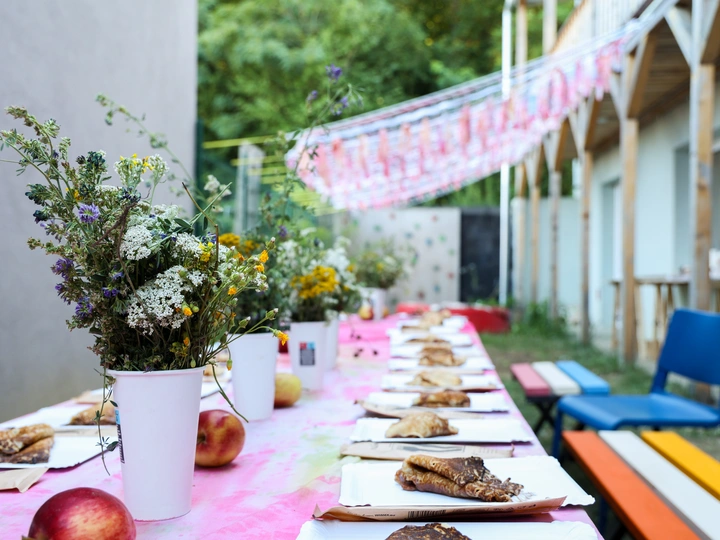
The process culminated in a public activation of the space, a community dinner, cultural programming and a film screening, bringing together residents and visitors in an informal setting that extended design into lived experience.
Luník CoLab is ultimately less about a single intervention than about testing a transferable approach: how can designers create conditions for communities to become authors of their own environments? We see it as an evolving methodology adaptable to other contexts where spatial, social and economic inequalities limit people's ability to shape the places they inhabit.