Flaring Oil in Paradise
I am an architect, urban historian and curator whose work explores how industry, extraction and corporate biopolitics shape cities, landscapes and collective memory. Across research, exhibitions and critical mapping, I investigate company towns as global laboratories of urbanization, connecting architectural history, political ecology and heritage.
I currently hold a Swiss National Science Foundation Postdoc.Mobility Fellowship at TU Delft, where my project Flaring Oil in Paradise investigates the oil company towns of Aruba and Curaçao and develops the first public atlas of industrial settlements in the Dutch Caribbean. My doctoral dissertation, Dalmine Lives: A Biopolitical History of an Italian Company Town, completed at the Swiss Federal Institute of Technology Lausanne (EPFL), received the EPFL Distinction for Best PhD Thesis in Architecture (2024).
My research has been supported through the Erasmus Mundus Programme, the US/ICOMOS International Exchange Program, the Marie Skłodowska-Curie doctoral programme and the Swiss National Science Foundation. I have taught, lectured and served as a design critic at EPFL, TU Delft, Politecnico di Milano and the University of Cincinnati, among others.
Alongside academic research, I curate exhibitions that translate historical evidence into public debate. I recently curated and designed Inclusive Heritage: Invisibilized Voices and Places at EPFL's Rolex Learning Center, an exhibition that continues to travel across Switzerland, exploring whose histories become heritage and whose remain invisible. My work has been published in academic, professional and public venues in English, French and Italian.
I see architecture as a way of reading systems of power through space. My work seeks to make overlooked landscapes visible and to create new public infrastructures for historical knowledge through exhibitions, atlases and collaborative digital platforms.
From colonial enterprises to contemporary corporations, urban design has been used as a tool to govern resource-rich territories, organize labour and shape landscapes of extraction. For over a decade, I have been studying company towns, settlements planned and managed by corporations. Often treated as isolated industrial experiments, they are part of a global urban phenomenon in which Europe played a central role throughout the twentieth century. While company towns in the Netherlands are well documented, their Caribbean counterparts remain largely absent from architectural history.
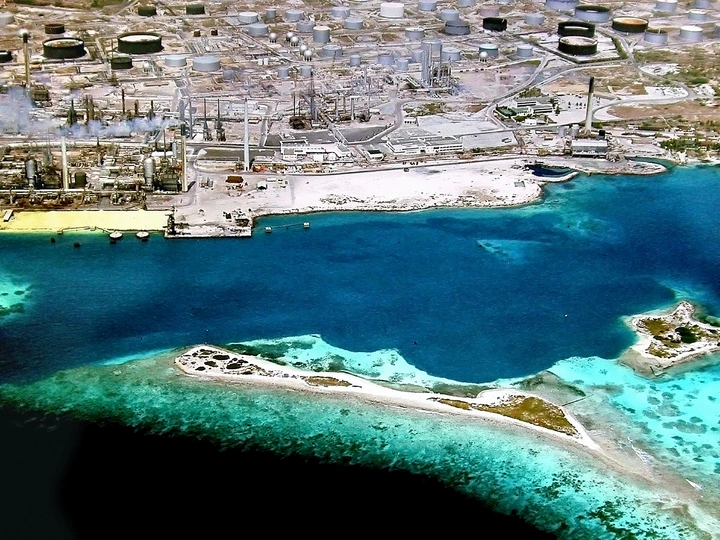
Between 1915 and 1985, Aruba and Curaçao hosted two of the world's largest oil refineries of Venezuelan crude. Entire urban landscapes were built with private capital to support production, their housing, schools, infrastructures, and public spaces reproducing corporate hierarchies of origin, skill and race. Although both islands remain constituent countries of the Kingdom of the Netherlands, this shared recent urban history remains largely untold.
Developed through my Swiss National Science Foundation Postdoctoral Fellowship at TU Delft, the project now expands into public formats. Archival records, oral histories and fieldwork reconstruct the spatial history of the towns and the environmental and social legacies of oil production. Rather than a closed archive, the aim is a collaborative platform where residents and Caribbean and Dutch organizations share microhistories and counter-narratives.
The project unfolds through three interconnected formats: an open digital atlas, an exhibition, and a publication. Each format offers a different way of engaging with the archive, transforming research into a collaborative, spatial and editorial framework for public debate. It connects institutional archives with lived experiences, revealing histories of labour, extraction and environmental justice that continue to shape European territories beyond the continent.