A TYPOLOGY FOR THE MENSTRUATING BODY
A graduate of Bauhaus University Weimar and TU Vienna, I have worked for several years in the fields of architecture, urban design, landscape planning, and social housing, in collaboration with the studios l'AUC, Altitude35, and feld72.
Since 2025, I co-organize and host Pendant Le Feu Rouge, an experimental event series that creates installations and holds a temporary space for women to share ideas and creative work.
I am an active member of the Pantin-based association BONJOUR, for which I have led various types of workshops in public space — construction workshops, cooking workshops, textile transformation, and more.
I have been developing a practice called Impulsive Field Production with Zoe Bilgeri, in which we explore the power and dynamics of textiles in public space. In a recent collaboration, we filmed and produced the artistic short film ZOFRI, showcasing a place shaped by the cravings for freely circulating goods (Alto Hospicio, Chile). It will premiere in December 2026 in Brussels with BEBE magazine.
I am also a performing artist in the theatre company Les Cri-Arts, where much of my thinking about the body, space, and collective practice actually comes from. In June 2026, we presented the piece Dramascule, based on Thomas Bernhard's work, and we are currently working on Visage de feu, by Marius von Mayenburg.
I am currently teaching summer classes in German to children with a migration background. Growing up in Südtirol, where friction between language groups is a lived, everyday experience, I have long been fascinated by the power of learning another language. I am currently studying my fifth: Arabic.
Across all of this, the same questions keep coming back: Who gets to shape shared space? How do we create the cities of tomorrow? How do we find cultural dynamics that work against gentrification rather than for it?
The European city can be read as a spatial answer to human needs. It has successfully transformed bodily and social practices into built spaces that enhance our everyday life. These translations are never static — practices shift, migrate, find new forms over time. Bathing, for instance, moved from the riverbank to collective bathhouses to the private bathroom, yet still surfaces on a city layer in municipal douches, thermal baths and swimming pools.
Privatisation of domestic processes and the rise of sanitary installations have worked as a displacement mechanism. Menstruation was not ignored. It was solved: through sanitary products and medication, its symptoms suppressed, its process made invisible, its bearer integrated into a normalised everyday life. Shame and taboo alone cannot account for this absence: even practices considered marginal or transgressive like prostitution have generated spatial forms in the city. Menstruation has not.
Feminist urban studies have analysed many dimensions of spatial inequality: public toilets, childcare, street lighting, access to sanitary products. They reveal what was considered claimable within the existing planning logic. Menstruation was never among them.
The city is an artefact that holds memories, histories, permanence and ideas that have traversed it. So argued the architect and theorist Aldo Rossi. The city is as much shaped by its geographical location as by the people who have lived or are living it — collective memory expressing itself in architecture.
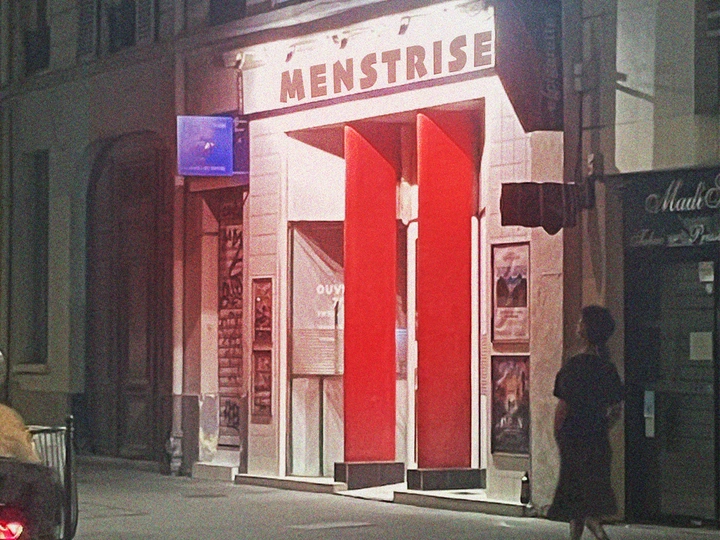
For many, menstruation comes with special bodily needs. Could a typology of menstruation build another culture of it? Could it turn isolation into community?
Im not asking of spiritual space like the Red Tent movement, where a deeper ideology manifests. No — I'm talking about the acceptance of a simple bodily need, its regularity: giving a bodily process spatial form, accessible to all women, no matter their religion, colour, or age.