HYDRO-POETIC ARCHITECTURES
I have 20 years of experience promoting and teaching artistic research, with an emphasis on decolonial ecocriticism, hydro-poetics, architectural thinking, and art history. I have collaborated with museums such as MoMA, MET, Center Pompidou, Museum of Latin American Art (Los Angeles), Reina Sofía, Gulbenkian Foundation, Pinacoteca do Estado do Sao Paulo, Museum of Contemporary Art of Chile, University Museum of Contemporary Art (MUAC ), San Agustín Arts Center (Oaxaca), ExTeresa Arte Actual, Havana Biennial, Hamburger Bahnhof (Berlin), Neuberger Museum (NY), the documenta of Kassel (Germany), ARCO (Madrid). In 2016 I was invited by the Secretary of Culture of Mexico to propose the curatorial project for the representation of Mexico at the Venice Biennale. As an educator I specialize in alternative pedagogies and museum studies with an emphasis on ecological transition and creative art archives. My published work has been translated into German, French, Korean, Portuguese, Spanish, Catalan, and Italian.
In recent years I have been researching the connection between architecture, water memories, and spatial poetics. The result is what I called Hydro-Poetic Architectures, a sort of more-than-human built environments. These ephemeral structures are not architectures for or about water. They are not designed to waterproofing, controlling, capturing, storing, harvesting, managing, or purifying water. They are interpermeable hydrosocial structures. They allow us to coexist with the poetic materiality of water. Hydro-Poetic Architectures help us to co-produce alternative water futures.
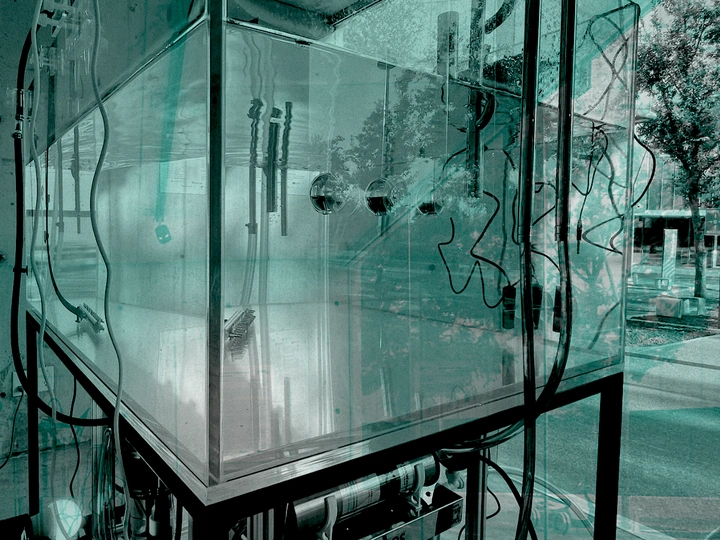
In collaboration with urbanists, water engineers, and computer technicians, I have developed a prototype called Hydro-Poetic Station. This piece use Nature-Based bioremediation techniques to convert water toxicity into AI-generative poems, allowing bodies of water to speak by themselves on ecological and climate change related topics. These architectures are interactive biochemical machines. They create poetic spaces where we can think with water.
By means of pumps, hoses, and filters, these organic machines keep the water flowing continuously, oxygenating its poetic materiality and permeable corporeality. A set of burettes pour micro doses of laccase enzymes produced by the Pycnoporus Sanguineus fungus to degrade the contaminating organic solids. Variations in biochemical parameters are monitored in real time through IoT sensors and sent to a RESTful API network via HTTPS protocol. The flow of ‘liquid data’ is recoded using an algorithm locally created with ChatGpt4 and trained on technical reports, ecology theory, environmental humanities, climate change news, and bioclimatic regenerative literature. Interactions take the form of Haikus displayed on three P10 Red LED screens. The result is a living hydro-generative writing in which machine, biotic, and more-than-human intelligences converge, confronting the future of AI with our water ecosystems crisis.