FILMITRO: Reading Public Space Through Film
Marigona Rexha
Leunita Syla
Public Space Equity (PSE) is a Kosovo-based think tank founded by three women architects, focused on public space as a foundation for social equity and active citizenship. Through interdisciplinary research, urban strategies and advocacy, we investigate how public spaces are designed, used and experienced, and how they can better respond to the communities they serve.
Our work connects research with civic and spatial action. We study accessibility, patterns of use and the social dimensions of public space while engaging citizens, professionals, institutions and policymakers. Through workshops, non-formal education and collaborative initiatives PSE creates opportunities for communities to participate in shaping and advocating for their shared spaces.
Our projects demonstrate how this process can lead to tangible change. Through Past Forward: Crafts Center of Mitrovica, PSE investigated the Crafts Center together with citizens and young professionals. The process identified its central atrium, a public space occupied by a private business, as a key concern. PSE brought the issue into public discussion and advocated for its release. Following this action, the Municipal Inspectorate cleared the atrium, returning it to public use.
FILMITRO demonstrates another dimension of our practice, combining community research, documentary film and tactical urbanism. Research findings were transformed into films, public discussions and spatial interventions, creating new ways for citizens to articulate concerns and participate in conversations about their city.
PSE translates research and community knowledge into interventions, recommendations and publications that inform public debate and advocate for more equitable urban policies.
FILMITRO is a participatory spatial practice developed in Mitrovica, Kosovo, using urban research, film and tactical intervention to ask: who is public space really for?
The project began from the everyday experiences of residents navigating unsafe, inaccessible or exclusionary urban spaces. Rather than treating these experiences as secondary to design, FILMITRO places them at the centre of spatial inquiry. In its first cycle, PSE combined an online survey with 110 residents, focus groups with women and persons with disabilities, interviews, and film and tactical-urbanism workshops, bringing community knowledge together with architecture, urbanism and visual storytelling.
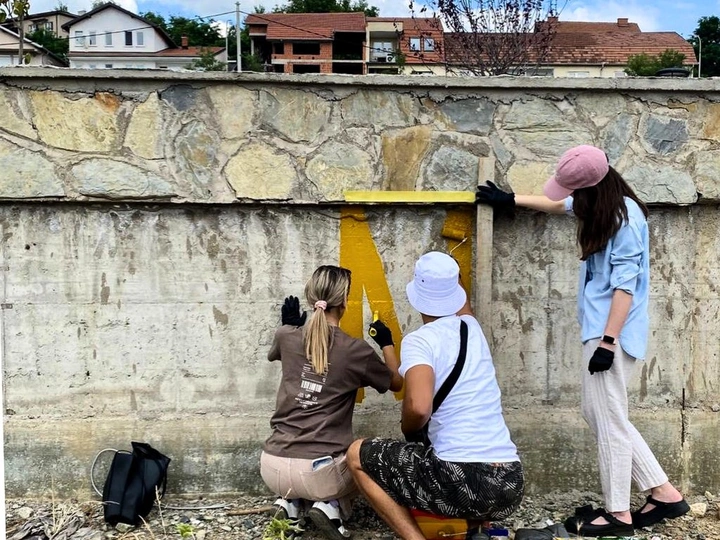
The research became a creative process. Around 15 young participants translated findings on access, safety, memory, exclusion and belonging into seven short films exploring Mitrovica’s river, abandoned public spaces, forgotten heritage, collective memory, public art and physical or symbolic barriers. The films were screened publicly and followed by discussion, turning documentation into civic conversation. A parallel tactical-urbanism workshop transformed research into small spatial actions, including an intervention highlighting the separation between a city park and the Iber River and a full-scale visualisation of an accessible ramp.
FILMITRO showed that citizens do not need to participate in the city only through formal consultation. Film, mapping, storytelling and temporary spatial actions can make hidden barriers legible, create dialogue and turn critique into collective imagination.
We see FILMITRO as a transferable methodology: listen > document > narrate > discuss > intervene. Through LINA, we want to test it in other European contexts, working with local communities and institutions to explore how cities experience access, care, memory and belonging, and how small acts of spatial storytelling can catalyse more equitable public space and inspire active citizenship.