Towards Open Hospitality:Translating Displacement
My name is Dimitra Gkampoura, and I am a 24-year-old architect who recently graduated from the five-year integrated Master's programme at the School of Architecture, Faculty of Engineering, Aristotle University of Thessaloniki, Greece.
My interests lie in architectural design and research, with a particular emphasis on graphic design and visual representation as tools for communicating ideas. I am particularly interested in the intersection of architecture with social and environmental issues, and in exploring how spatial practices can function as socially responsible forms of inquiry and intervention.
Through my work, I aim to approach architecture both as a creative discipline and as a critical framework for addressing contemporary challenges. I enjoy working across different scales and media, combining analytical thinking with experimentation to develop meaningful spatial narratives.
I am always interested in opportunities that encourage collaboration, research, and interdisciplinary exchange, allowing architecture to become a platform for dialogue, innovation, and positive social impact.
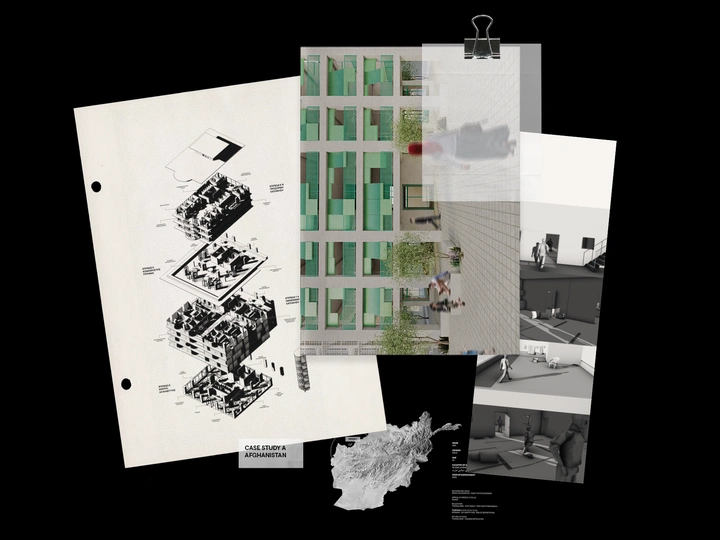
This diploma thesis investigates the potential for developing an open urban typology of refugee hospitality through the adaptive reuse of vacant or underutilized buildings within the existing urban fabric and the application of replicable architectural interventions. Rather than creating isolated accommodation facilities, the proposal explores the integration of refugees into the city through the reuse of vacant buildings and the development of a flexible housing system. Its primary objective is to establish a decentralized network of affordable and inclusive hospitality that understands dwelling not as a temporary emergency response but as a condition of everyday life supporting privacy, sociability, familiarity, and personal autonomy. The research methodology combines semi-structured interviews with the method of situated testimony, drawing on practices developed by the research agency Forensic Architecture. Through the digital reconstruction of the home environments of three people with refugee experience, the study examined spatial memories, domestic practices, and modes of spatial appropriation. The analysis identified recurring patterns, including the importance of threshold spaces, flexible domestic layouts, and the gradation of privacy, which informed the design principles. The proposal is tested through a pilot intervention in an unfinished building in Thessaloniki, Greece. The program includes an open solidarity and support center at ground level, semi-permanent housing units, a floor dedicated to collective activities, and temporary accommodation organized through a cooperative cohabitation model. The flexible housing system adapts to changing user needs through spatial and bioclimatic strategies, including expanded balconies creating intermediate climatic spaces, adaptable internal partitions, and internal balconies that mediate privacy. The thesis concludes by proposing a framework for refugee hospitality promoting inclusion and dignified living for all