A powerful green shield.
My journey as an architect has taken me across diverse cultural and professional contexts. During my master's thesis in Buenos Aires, I explored how architecture and urbanism can create more equitable opportunities for underserved communities. The project was later recognized with an award in an international competition. I then worked in a small practice in Portugal, where I learned from vernacular architecture and community-led design, before moving to Barcelona to complete a second master's degree and work on large-scale international projects.
These experiences strengthened my belief that architecture is not only about buildings but about expanding opportunities, protecting the environment, and shaping more inclusive futures. I am interested in combining emerging technologies, natural materials, and traditional building knowledge to develop resilient and sustainable solutions. I believe meaningful architecture begins by listening and by enabling people to actively shape the places they inhabit.
Alongside my professional practice, I am developing Design Matter Studio, an independent initiative that makes architecture and design more accessible beyond the profession. Its goal is to help people better understand the built environment and recognize how design influences everyday life, encouraging broader participation in shaping more thoughtful, sustainable, and inclusive places.
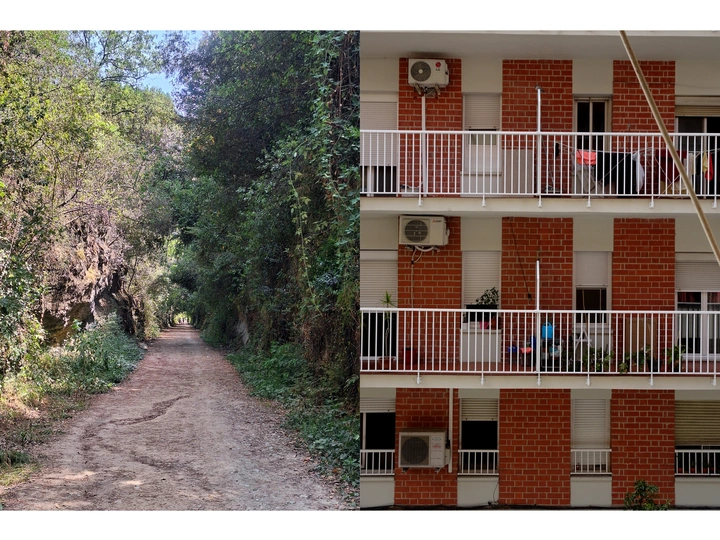
As European cities overheat, climate adaptation remains focused on new developments, while existing housing, particularly in historic neighborhoods, is often left behind. Residents increasingly rely on air conditioning: expensive, energy-intensive, visually intrusive, and inaccessible to many. A Powerful Green Shield asks: how can we rethink climate adaptation for the buildings we already have?
The project investigates transformable green facades as seasonal public infrastructure. Green corridors have been shown to lower asphalt temperature by up to 40°C; green facades, interior temperatures by up to 13°C. Instead of remaining permanently attached, lightweight vegetated systems would be installed during the hottest months to reduce heat gain and improve thermal comfort, then dismantled and reconfigured into shaded canopies or neighborhood pavilions during cooler months, extending their usefulness year-round while easing concerns over humidity and long-term impact on historic buildings.
Green infrastructure has consistently cooled urban environments, yet its application to heritage architecture remains limited by concerns over aesthetics, structural load, and conservation. This research explores whether a reversible, adaptable system can overcome these barriers, opening a dialogue between preservation and innovation.
Through community participation and public funding, climate adaptation becomes a shared civic resource rather than an individual investment, accessible to working- and middle-class neighborhoods.
Poble-Sec, Barcelona, offers an ideal testing ground: buildings with full southern exposure, poor cross ventilation, and facades covered by air-conditioning units, on narrow streets where trees struggle to grow. Rather than treating heritage as static, A Powerful Green Shield proposes existing buildings become active participants in their own adaptation, transforming with the seasons, and with the city around them.