How do we live today?
Telmo Escapil-Inchauspé (1998) is an Architect, Urbanist (ETSAM-UPM / ENSA Versailles) and Historian (Paris-Saclay).
He is a member of l’AUC (P.Abercrombie Prize of the International Union of Architects), where he oversees complex architectural, urban, landscape, and territorial projects.
He has taught and collaborated with numerous international institutions (Versailles Castle; ETSAM; MIT; ParisSaclay; FAU Porto; Architectural Association; California Polytechnic State University…). His research has led to multiple publications, lectures, and exhibitions (IFOU, ETH Zürich, Rice Architecture, Graham Foundation, UCLA, Pavillon de l’Arsenal, Brussels Center for Architecture & Landscape, Flemish Architecture Institute, Institut Culturel de Wallonie, Cambridge University…).
His practice is defined by an exceptional breadth of perspectives, extending from architectural writing to the monitoring of complex sites. Working across diverse geographical contexts and engaging with a wide spectrum of stakeholders, from civil society, institutions, researchers, practitioners to governments, he has developed a holistic understanding of the environmental, social, political, and cultural determinants that shape contemporary architecture and urbanism.
His contributions are acknowledged through his status as a Rolex and Norman Foster Foundation Scholar and as a young ICOMOS expert.
The research seeks to develop a systemic understanding of the factors shaping architectural and urban production at the European scale by examining contemporary policies, housing markets, construction economies, demographic shifts, legislative frameworks, environmental conditions, and evolving modes of inhabitation. It aims to identify strategic opportunities through which architects can engage more critically with the economic and territorial forces shaping the future of housing.
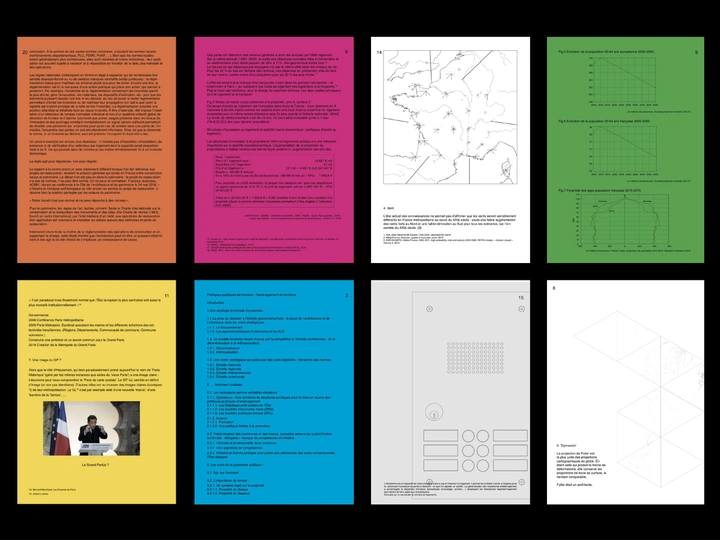
The scientific analysis focused on the present and projected (to 2050) determinants and conditions of architecture, using IPCC RCP8.5 climate scenarios as a reference framework. It was structured around six thematic booklets: Territorial Policies; Housing Markets and Construction Economies; Populations; Legal Frameworks; Regulatory Environments; Greater Metropolises; and Everyday Spaces.
Conducted in collaboration with Guilhem Solère, the research was conceived as a framework for continuous action. It has generated multiple outcomes, including architectural projects, legislative proposals, support for citizen initiatives, and the dissemination of knowledge among stakeholders, while contributing to the expansion of public debate.
The different outcomes of this research had the goal to demonstrate that these determinants should not be understood merely as constraints, but as potential design instruments. Like hackers working within existing systems, architects can reveal and transform the mechanisms shaping the built environment. By critically engaging with these conditions, architectural quality can emerge not despite the realities of the present, but through their deliberate understanding and reinterpretation as opportunities for shaping desirable futures attuned to our ever-changing environments.