Family House — A Symbol of Renewal
I am Olha Parfeniuk, an interior designer who has felt since childhood that this profession was created for me. Born into an artist’s family, I was not drawn to the canvas but to form — to volume, light, and texture, and to the possibility of bringing the world from my imagination into reality. After completing my education, I fully immersed myself in the profession, working on large-scale projects.
With the arrival of 2022, everything changed. It took me three years of war to return to creating. My practice is no longer design for the sake of design — it is a pursuit of shaping the style of my Ukraine, a search for everyday elements that can be reinterpreted and revived in contemporary Ukrainian design.
Before the war, I enjoyed the freedom of working across different styles. Today, my mission is to popularize and strengthen Ukrainian design, ensuring that our cultural identity is not only preserved but evolves into a powerful voice for the future.
Family House is a concept of renewal born from the tragedy of loss and the desire for recovery. It reinterprets ecology through the experience of war, showing how sustainable solutions become a path to survival and future resilience.
As a designer living in Ukraine during the war, I witnessed how perception changed — ecology is no longer only about preserving nature, but about saving lives. Centralized energy systems became vulnerable targets, so the project relies entirely on solar and wind power, ensuring independence and continuity.
Russia has destroyed more than 1,200 towns and villages, turning dozens of cities Between 210,000 and 236,000 buildings have been damaged or demolished.
Yet despite this devastation, we know the day will come when our cities and villages will be rebuilt. Even if they resemble post-apocalyptic landscapes, they will rise again — with memory of the past and faith in the future.
Family House symbolizes the lost sense of safety remembered from childhood — a home where generations lived together. Its purpose is to create a space that helps communities heal and reconnect. The building includes a 1200 m² underground shelter for up to 1000 people, multifunctional halls, and an art space with works of local artists rescued during the war. Here, people gather for art therapy, workshops, and cultural events, finding both emotional and physical support.
Community participation is essential: residents mix clay for walls, weave reed roofs, and local artisans contribute their craftsmanship. This collective process fosters belonging and unity, turning construction into a shared act of renewal.
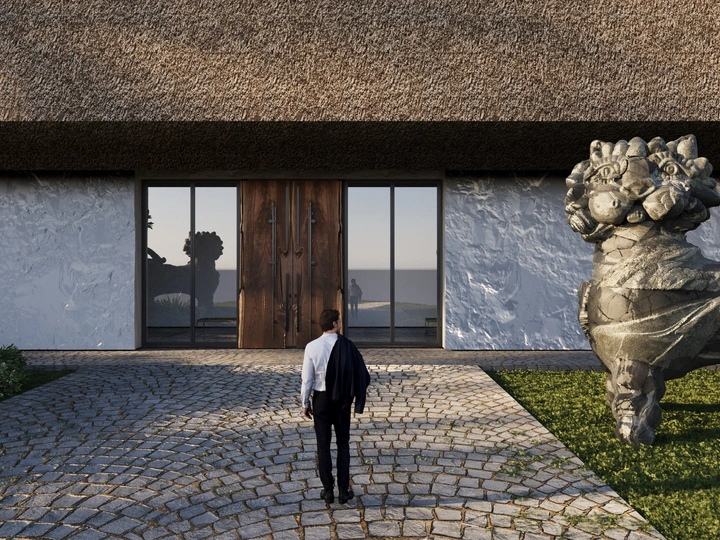
Architecturally, the project reinterprets the Ukrainian khata-mazanka with lime-washed walls, reed roofing, and a wooden dome interior. A central installation of the “Pavuk” symbolizes harmony and generational continuity.
Family House is not only architecture — it is a manifesto of hope, where memory becomes the foundation for a sustainable future.