Topography of Home
Olha Tuharinova is a Ukrainian filmmaker and producer based in Kyiv. With a background in architecture, her practice combines documentary cinema, autoethnography, and artistic research to explore how personal experience intersects with larger social, historical, and spatial processes.
Before co-founding Kshtalt Productions, a film production company dedicated to creative documentaries and hybrid cinema, she worked with film festivals, NGOs, and cultural institutions, including the 86 International Festival of Film and Urbanism, Goethe-Institut Ukraine, and German Films. These interdisciplinary experiences continue to shape her approach to cinema as a method of artistic inquiry.
Olha graduated from DocNomads, the Erasmus Mundus Joint Master’s in Documentary Directing, and is an alumna of EURODOC and Sarajevo Talents 2025. Her films and projects have been presented at Ji.hlava IDFF, Doc Lab Poland, Baltic Sea Docs, DOK Co-Pro Market, CPH:DOX CHANGE, ZagrebDox PRO, Verzio DocLab, and Agora Thessaloniki.
Her current work investigates how war reshapes the experience of home and identity, and how cinema can reveal traces of memory embedded in everyday environments.
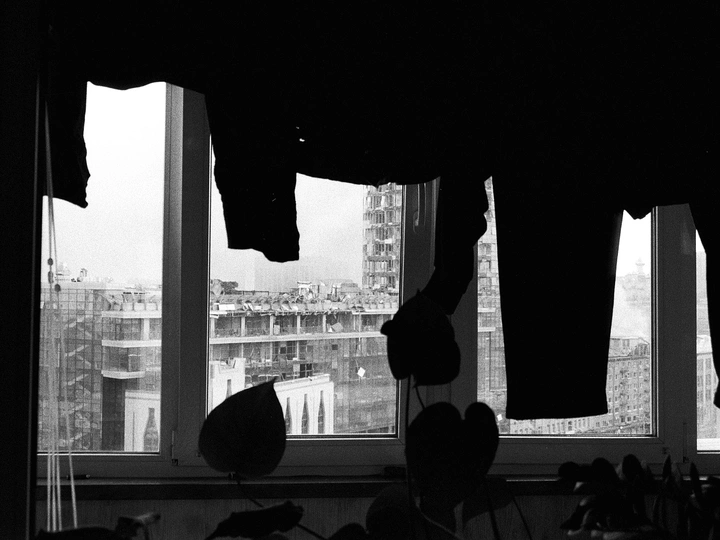
Topography of Home is an audiovisual essay exploring how the experience of home changes after returning from places of safety to a city still living through war. The project follows the everyday process of learning to inhabit familiar spaces transformed by prolonged catastrophe. Returning home becomes no single moment of arrival, but a continuous negotiation between memory, adaptation, and ordinary life.
The project approaches home as a spatial condition shaped through everyday practices—old and new, preserved and invented, instinctive and adapted. Partially destroyed apartment buildings remain inhabited. Plywood replaces shattered glass. Familiar routes are marked by craters and traces of shrapnel. War reveals itself through these ordinary details. Together, they form a landscape of inhabited ruins, where destruction, reconstruction, and daily life coexist and gradually reshape the meaning of home.
Developed as an essay film, the project combines observation, personal narration, spatial research, and an original soundscape created in collaboration with sound artist Daina Dieva. Cinema and sound become methods of reading the built environment, tracing how architecture absorbs history and carries lived experience into the future. Inspired by Jean-Gabriel Périot’s 200,000 Phantoms, the project considers the city as a layered audiovisual archive in which past violence remains present even as buildings, surfaces, sounds, and everyday life continue to change.
Rooted in the author’s personal experience of returning to a country at war, the project asks a broader question: how does prolonged catastrophe change the ways we inhabit, perceive, and remember familiar places? Topography of Home proposes a cinematic framework for understanding home as a relationship with space, continuously redefined through everyday life under extraordinary conditions.