HUT-SPOT. Biodiversity habitat device
Maria Vittoria Tesei
Established in 2018 by Maria Vittoria Tesei (architect and urban planner) and Flavio Martella (PhD architect and engineer), m²ft architects explores the complexities of architecture by bridging multiple disciplines, including architecture, ecology, sociology, urbanism, and landscape. Our core focus is to investigate this intersectionality, creating innovative solutions that transcend conventional structures and challenge standard building paradigms.
Grounded in this philosophy, we design projects that look beyond formal expression to actively fulfill functional needs, deeply integrating environmental and social considerations. We strive for a harmonious balance between a progressive urban vision and rigorous design implementation. This equilibrium allows us to deliver impactful, sustainable projects that benefit both local communities and the surrounding environment, fostering a resilient relationship between human habitats and natural ecosystems.
Beyond architectural and urban design, m²ft architects actively contributes to the wider disciplinary conversation through a substantial body of theoretical work. This dual commitment to research and practice adds critical depth to our design approach, resulting in conscious, highly contextualized architecture. By synthesizing academic research, critical insights, and material innovations, our practice positions itself to help understand contemporary lifestyles while actively shaping the dialogues surrounding them.
Through temporary interventions, material experimentation, and site-specific prototypes like HUT-SPOT, we investigate urban ecology and spontaneous nature in the city. Our work examines how the built environment can coexist with living systems, addressing habitat fragmentation and promoting multispecies inclusivity.
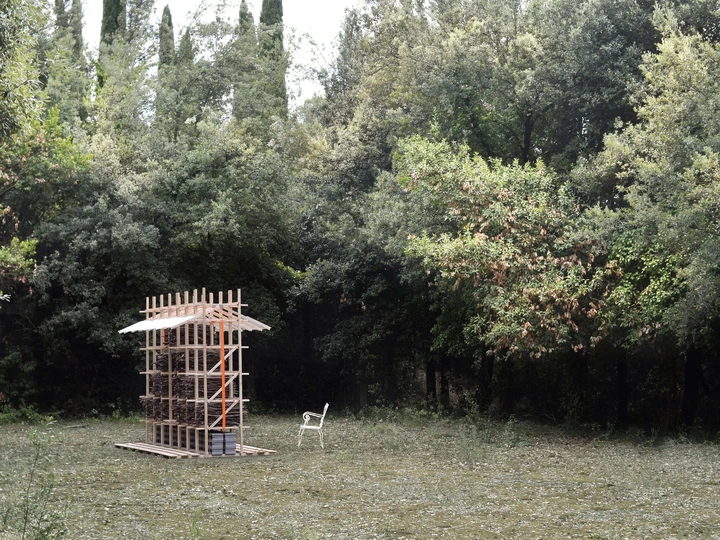
HUT-SPOT stands on the edge of a woodland where the Romagna hills' vegetation reclaims an abandoned asphalted tennis court. Marking a threshold between two worlds, it gathers prunings and dry branches into a modular timber framework, forming a layering of residues that is both primordial and contemporary.
The name embodies a dual nature: 'hotspot' refers to high biodiversity and connectivity, while 'hut' evokes a basic shelter for every form of life. It translates these meanings into a prototype adaptable to urban contexts as a small-scale biodiversity hub.
Built on contrasts—between the human framework and organic content, regular grids and irregular pruning, artificial and natural elements—the modular voids house branches as fragments of local undergrowth repositioned within the forest’s cycle.
HUT-SPOT is a shared refuge against habitat fragmentation, supporting microhabitats where decomposition nourishes fungi, bacteria, insects, birds, and small mammals. A central seat invites humans to share shelter and connection with other species, envisioning new forms of closeness between humans and non-humans.