it's getting hot in here, so...cover it up?
Eleonora is a Belgian-Italian architectural engineer. She hold an MSc in architectural engineering from the Brussels Engineering Faculty (Bruface, ULB/VUB). Her master thesis was written about biomimetic optimisation, and was graded Summa Cum Laude. She won international awards for that research, including the Belgian Ingénieurs Sans Frontières 2022 award, 2nd place at the European Switch2Save contest of 2023, as well as a special feature in DailyScience Belgium.
She has been working for over three years, and specialises in environmental design and building performance. Currently, she's working on public buildings in an international architectural office in Belgium, as an architect and researcher/innovator on the broad topics of sustainability and materials.
She has been published twice, once on the topic of biomimicry in biomimetics mdpi, and once for a Horizon 2020 research project, which was presented at the SBE25 conference.
Nature holds a strong place in her vision, and only reinforces her idea that architecture should be respectful and integrated. The way we currently build should be fundamentally reconsidered. In today’s context of climate and biodiversity crises, she believes it is essential to radically rethink how and why we build. Ultimately, she even questions whether we should build at all.
Why this work began and where it is going
This work started as my Master Thesis, which I wrote during the academic year 2021-2022. I received the grade Summa Cum Laude (19/20) as well as awards. Since then, I have been working for 3.5 years, first as an environmental consultant then as an architectural engineer - currently spending half my time designing and the other researching. My focus has always been on natural architecture and sustainability. Thanks to this working experience, I am seeing some gaps in this original work, which will be explored throughout this project.
Proposal description
The construction sector is responsible for approximately 40% of global CO2 emissions, directly impacting climate change. A building envelope plays a crucial role, and its inefficiency accounts for a substantial portion of energy losses. Currently, Belgian renovation strategies include insulating with standard materials inside, outside, or within walls. What if nature could provide us with new solutions?
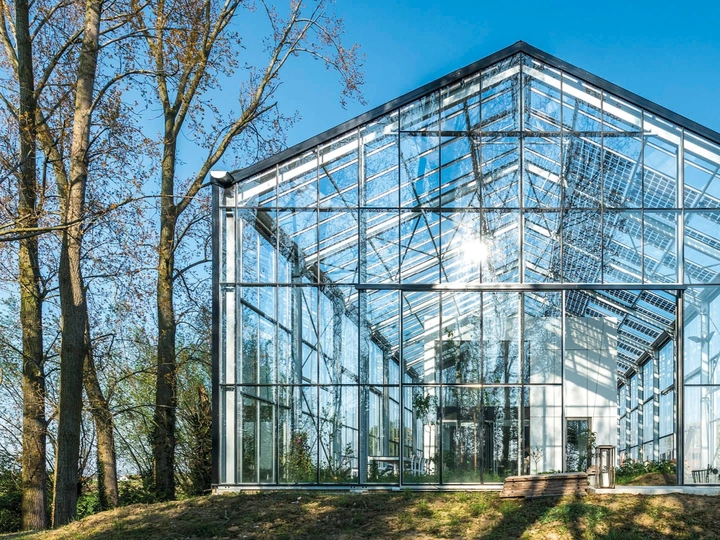
In that context, this proposal explores the concept of enclosing a house in a greenhouse (HGH) as an effective alternative to traditional insulation methods. Some built examples exist in Sweden and Belgium. The greenhouse acts like a double skin, insulating thermally and acoustically the core house, providing food, water filtration, biophilic effects, renewable energy collection, and creating comfortable semi-external spaces.
This concept however comes with some shortcomings, such as high humidity and poor daylighting control, overheating and condensation, obstructed views, high embodied carbon. To that effect, architectural biomimetic strategies are explored to optimise the HGH and create "superscenarios" that solve all of the problems identified.This is carried out through a research-by-design process.