Mavica
Martin Volman is an Argentine artist, sociologist and design researcher based in Berlin. His practice examines how images, documents and technical systems organise visibility, value, memory and belonging. Working across photography, installation, moving image, archival research and publication, he investigates the material and political conditions through which institutions classify people, objects and spaces.
His work often begins with formats that appear secondary or obsolete: floppy disks, photographic envelopes, carbon paper, thermal receipts, security patterns, contact sheets, administrative folders, official signs and legal symbols. Rather than treating these materials as nostalgic remains, he approaches them as active systems of organisation. They store, delay, duplicate, erase, protect and assign value. Through serial arrangements, fictional archives, spatial installations and reconstructed bureaucratic procedures, he explores how technical and administrative infrastructures shape what can be seen, preserved or recognised.
Volman holds a BA in Sociology from Universidad del Salvador in Buenos Aires and an MSc in Design Research developed across Hochschule Anhalt, Bauhaus Dessau and Humboldt-Universität zu Berlin. His academic research focused on how institutions and design systems construct subjects as objects of knowledge. His artistic practice extends this inquiry into photographic culture, obsolete media, migration, provisional legal status and the spatial effects of classification.
His projects have been presented in Berlin in contexts including 48 Stunden Neukölln, Zönotéka, Juraplatz, Il Kino and projects connected to UdK Berlin. He is a member of the German Photographic Society (DGPh) and has participated in Ilit Azoulay’s MasterClass.
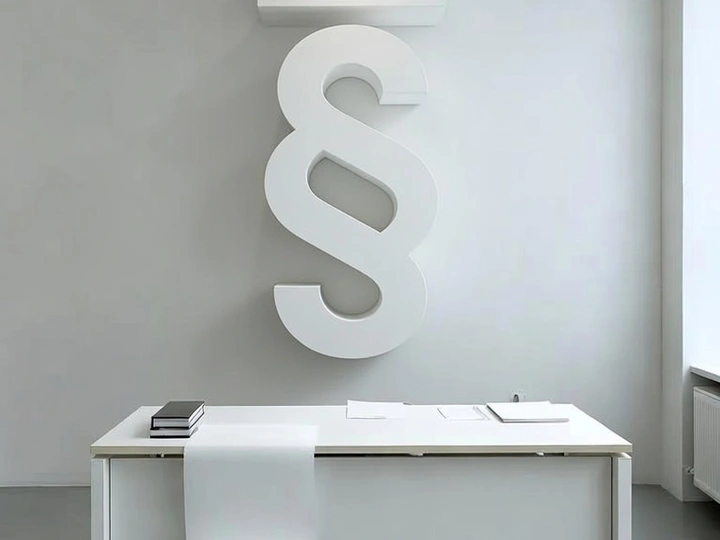
AMTLICHE BILDBESCHREIBUNG begins with the paragraph sign, §, treated not as punctuation but as artistic and spatial material. What does this sign promise when the article to which it refers is absent? Where does authority reside when a legal reference leads only to another delay? Detached from a specific provision, § becomes the typographic expression of suspended time.
The project grows from my experience as an immigrant artist navigating German bureaucracy through documents such as the Fiktionsbescheinigung and Aufenthaltstitel. A
A related structure operates spatially through Zwischennutzung, or interim use. A building is permitted to function temporarily until its supposedly definitive use begins.
The project takes the form of a fictional Office for Provisional Structures. Installed within a host institution or interim space, it registers signs, documents, architectural elements and forms of occupation whose status remains unresolved. The Office produces files, permits, classifications and paragraph references for a territory that never becomes stable.
Its material language borrows from bureaucratic media (letraset, paper, carbon copies, letraset, security patterns, floor markings among others). These materials do not merely illustrate bureaucracy; each performs a different temporal condition. Carbon paper creates a weaker secondary record. Thermal printing turns evidence into gradual disappearance. Empty folders preserve classification without resolving what has been classified. Repeated § signs transform legislation into an atmosphere through which bodies move.
Through LINA, this project would investigate local forms of provisional existence: interim buildings, threatened infrastructures, temporary permits, contested land use and institutions awaiting redevelopment.