The Covered Commons - A new urban typology
I’m an architect and creative working globally across disciplines.
Working independently gives me the freedom to collaborate with anyone, empowering people through design and the reimagining of spaces that foster freedom and movement. I am driven by strategies for more sustainable and resilient future narratives that are both socially and spatially conscious.
At the heart of my work are three-dimensional narratives, ranging from small to large-scale projects.
For me, it’s not about status or wealth—it’s about great ideas, inspiring people, and the courage to stand by them. I come from a DIY culture-rich scene that values participation, co-creation, and responsibility—principles that have shaped my identity.
The Covered Commons tries to give a direct answer to three challenges at once: climate change, a digital era where people spend most of their social lives behind screens, and the ongoing privatisation of public space.
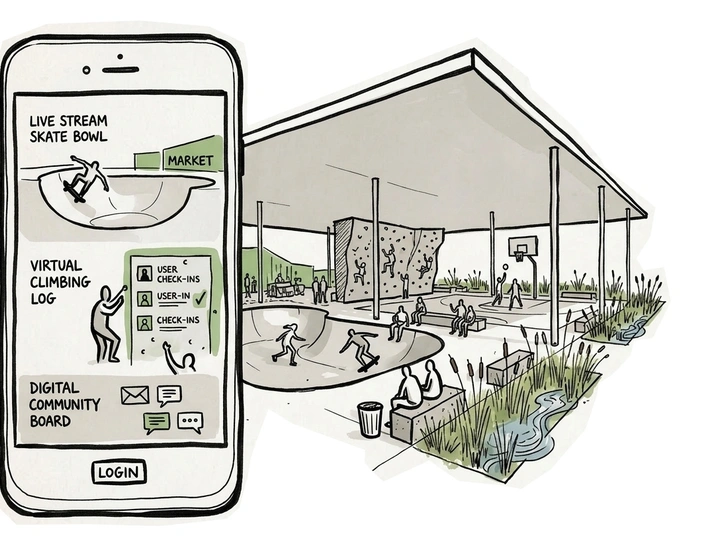
The answer is a new urban typology: a covered space that shelters from summer heatwaves, rainy autumns and windy cold winters, open 24/7 to everyone, hosting sport, cultural and other events that are funded, run and governed by the users themselves — directly on site and through an online platform and mobile application tied to the space, where people can organise events, crowdfund upgrades and take decisions together.
The space exists simultaneously online and in real life, and the online half is just as crucial to its existence as the roof. But the digital space is designed against itself: the goal is to get users off their phones as quickly as possible and into the space physically, either as active users or as observers of something happening there. Live feeds from the space work the same way, closer to how Surfline broadcasts surf sessions.
I started thinking about this idea after years designing skateparks and watching the same pattern repeat: informal urban sport and public life get pushed indoors behind admission fees, or left outdoors at the mercy of more and more unpredictable and harsh weather. At the same time, so much social life has moved into apps that have no physical counterpart at all. The Covered Commons is meant to close that gap in both directions: a real place that people occupy and shape, and a digital space that lets them do that even when they are not standing there.
Malmö could be the pilot city, but the intention is a replicable model rather than a single project.
This is still a brainstorming stage idea. I think it could go much further developed together with architects, urban planners, software developers and other professions this idea would benefit from, in order to become real.