+1.4°C
Shéryl Blauvac (me)
Fédération Wallonie-Bruxelles Création Artistique
Clément Gaillard
TASIBEL Natural Fibre Flooring
Anne Masson office : chevalier-masson
Helen Van de Vloet and Nathan Heindrichs office : Specs.work
Shéryl Blauvac is a textile designer and researcher based in Brussels. Her practice operates at the intersection of textile design and architecture, exploring how adaptive textile systems can help buildings and public spaces respond to climate change through low-tech strategies.
Whether designing woven textiles from natural fibres or transforming reclaimed advertising banners into architectural installations, she develops textile systems that combine material research, textile design and spatial intervention. Drawing on historical references, vernacular knowledge and full-scale experimentation, her work investigates how textiles can contribute to more resilient, reversible and adaptable forms of architecture.
She began developing +1.4°C during her Master's degree in Textile Design at ENSAV La Cambre in 2023. Since then, the project has evolved into an ongoing research practice combining textile creation, material development, prototyping and architectural installation. Working closely with architects, manufacturers and cultural institutions, she develops and tests full-scale prototypes that bridge craft, industrial production and architectural practice.
Her research has been supported by the Fédération Wallonie-Bruxelles through a research grant and presented through exhibitions, conferences and publications. Through her work, she aims to reconnect architecture with textile knowledge and demonstrate that adaptive textile systems are not secondary architectural elements, but essential tools for climate resilience.
The climate is changing faster than our buildings can adapt.
+1.4°C explores textiles as adaptive climate infrastructures for architecture and public space.
The project began during the 2023 Paris heatwave, when I noticed survival blankets covering apartment windows. Designed for emergencies, they had become improvised protection against overheating. This observation raised the question that drives my research: can textiles become a low-tech climate infrastructure for architecture and public space?
For centuries, textiles helped buildings adapt through curtains, awnings, tents and shade sails. Today, these flexible systems have disappeared, replaced by energy-intensive cooling. My research explores how textiles can once again become active architectural elements, offering seasonal, reversible and low-carbon solutions for thermal comfort.
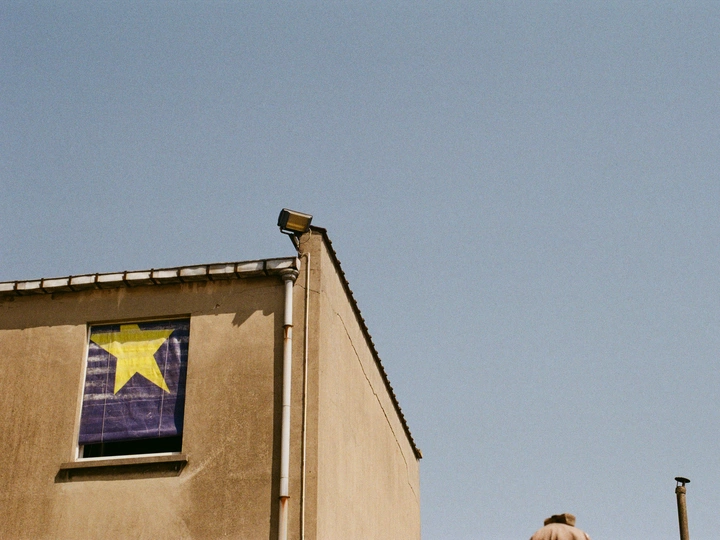
Rather than creating one universal product, I develop site-specific textile systems using local resources and knowledge. In Brussels, I transform discarded advertising banners into modular shading systems installed on the façade of Recyclart, a cultural and social centre. In parallel, I collaborate with the Belgian manufacturer Tasibel to develop woven architectural textiles from sisal (a cactus from agave sisalana), and I would like to explore other European plant-based fibres such as flax and hemp.
I collaborate with architects, manufacturers, designers, cultural and political institutions to build, install and test the prototypes I develop in real-life conditions.
Through LINA, I want to learn from regions already adapted to heat, exchange knowledge with European practitioners and explore how local materials, skills and traditions can inspire new textile infrastructures. My ambition is to reconnect architecture with textile knowledge and practices, showing that textile systems are not secondary architectural elements but essential components for helping buildings and public spaces adapt to a warmer future.