Klüfa - Küche für alle / Kitchen for everyone
After completing my Bachelor's degree in Architecture, I gained experience in exhibition design at Jangeld Nerves, contributed to the 7th Herbstsalon exhibition at Maxim Gorki Theater, and completed a research internship at Kooperative für Darstellungspolitik. I have also worked in scenography and props for film and television productions, giving me experience across concept development, production, and spatial implementation.
I am particularly interested in collaborative, interdisciplinary approaches to architecture that engage with public space, cultural production, and collective forms of knowledge. Through my work, I aim to create spaces that encourage participation, dialogue, and new ways of experiencing the built environment.
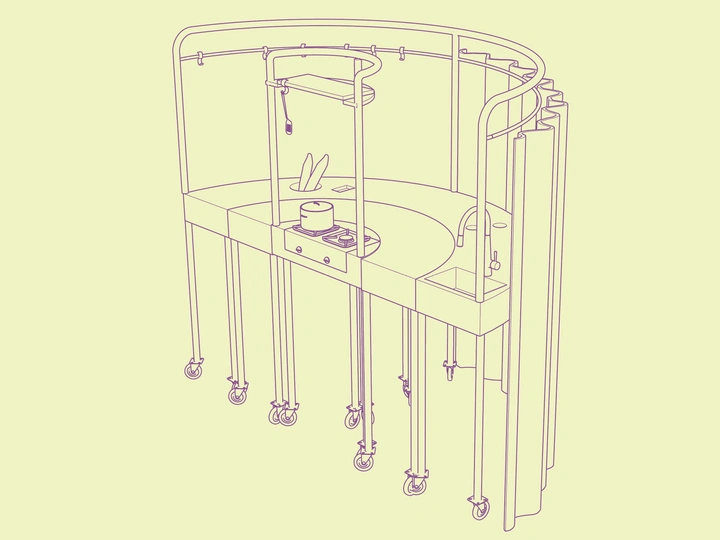
**Klüfa** is a speculative yet practice-oriented project exploring how architecture can foster social cohesion through the everyday act of cooking and eating together. It asks how underused urban spaces can become places of encounter rather than consumption.
The project responds to two parallel developments in many Western cities: the rise of convenience over communal dining and the gentrification driven by constantly changing commercial concepts. These processes often leave vacant retail spaces while weakening local social ties. Klüfa proposes an alternative by temporarily activating these spaces with a modular, mobile kitchen that enables collective cooking and shared meals.
Inspired by my Moldovan family background, where preparing and sharing food is a central social ritual, the project explores hospitality as a spatial strategy for participation, inclusion, and exchange across generations and cultures.
Klüfa consists of three modular kitchen units that can function independently, combine into a larger workspace, or nest together for transport and storage. Their plug-in construction allows quick assembly, making the system adaptable to different urban contexts. Rather than creating a permanent building, it provides an infrastructure for temporary, community-led occupation.
The project's value lies less in the object itself than in the encounters it enables. By inviting people to contribute ingredients, recipes, skills, or simply their presence, the kitchen becomes a catalyst for dialogue, collaboration, and collective ownership. Public space is reimagined as a shared kitchen and dining room where everyday practices create new forms of belonging.
As an open framework rather than a fixed design, Klüfa can evolve with local communities. It demonstrates how small, adaptable architectural interventions can reactivate vacant spaces while addressing broader questions of care, inclusion, and the social role of architecture.