Ubiquitous: Toward a Homeostatic Ecology
Ayfer Idil Kemaloglu is an artist, architect, curator and educator whose practice connects visual art, spatial design, ecology and scientific research. Born in Ankara and based in France, she studied architecture at Politecnico di Milano and the École Nationale Supérieure d’Architecture de Lyon, and holds a Master’s degree in Visual Arts and Contemporary Creation from Université Paris 1 Panthéon-Sorbonne.
Her work focuses on natural intelligence, biomimicry and speculative urbanism, with particular attention to lichens as ecological indicators and models for spatial thinking. She develops this research through installations, drawings, models, exhibitions, publications and pedagogical formats.
Alongside her artistic practice, she designs and leads art-and-architecture workshops for children, teaches in higher education and works as a curator. She is a member of AICA and La Maison des Artistes, and founded association Ubiquitous.Lab in 2026 to extend her research into collective ecological learning and experimentation.
Ubiquitous translates natural intelligence into tools for biomimetic urbanization. It asks how architecture and artistic practice can learn from the adaptive strategies of living systems to respond to environmental instability and develop post-anthropocentric ways of inhabiting space.
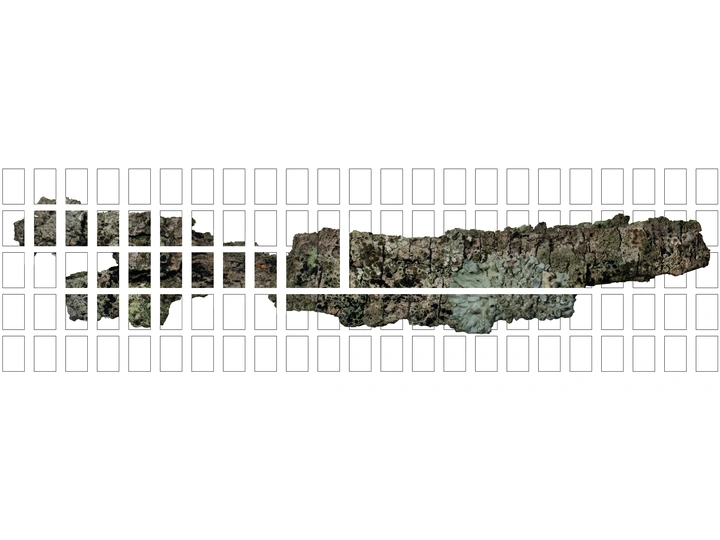
The research started in 2017 , takes lichens as ecological models and sources of knowledge. Their symbiotic organisation, poikilohydric behaviour and capacity to register environmental conditions reveal transformations in the territories they inhabit. Through Ubiquitous, biological behaviours and ecological data become spatial parameters rather than fixed architectural forms.
The methodology unfolds through six interconnected movements: ecological observation, amorphous drawing, geometric abstraction, topological transformation, grid construction and spatial synthesis. Field research, microscopy, mapping, artistic experimentation and digital fabrication generate site-specific drawings, models, installations and speculative urban configurations. Each application begins with an organism and territory, allowing the methodology to produce different outcomes across different ecological contexts.
In 2023 -2024 project build on research developed with scientists at Sorbonne University, where lichenology, climate research and artistic mediation became an exhibition and workshops for children. In Ayvalık, fieldwork, Mediterranean ecologies, microscopy and material experimentation were developed with Gate 27 and Sabancı University research centres. These experiences established public transmission as integral to the methodology.
the next phase introduces homeostatic ecology as a framework for studying adaptive ecological behaviours and the interactions. Through collaborations in new territories, Ubiquitous will develop ecological field protocols, spatial prototypes, exhibitions and collective workshops that make these interdependencies visible and open them to architectural experimentation.