A Vila do Mañá: The City at Play
Esmeralda Vázquez Prieto
A Vila do Mañá is a participatory spatial practice founded in Galicia in December 2016 by architect Sandra González Álvarez. It works with children and teenagers through architecture, play, art and urban action, creating processes in which they can read, question and transform the places they inhabit.
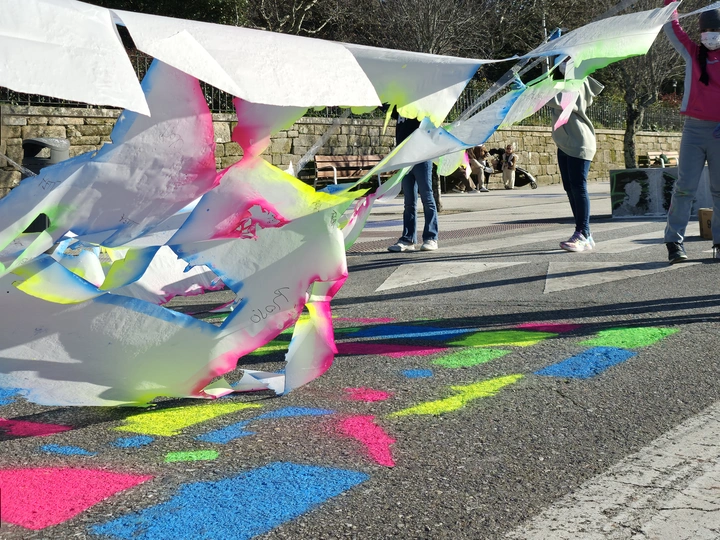
The practice combines research, mediation, co-design and direct intervention in public space. Its work ranges from urban walks, mappings and collective storytelling to temporary occupations, large-scale games, traffic-calming actions, literary routes and site-specific installations. Each project emerges from the identity, conflicts, memories and everyday conditions of a particular place.
Sandra González Álvarez is the project’s founder and director. She is an architect, researcher and doctoral candidate in Architecture and Urbanism at the Universidade da Coruña and Universidade Presbiteriana Mackenzie in São Paulo. Her interests include child-led participation, spatial justice, urban pedagogy, public space, care, local memory and the rehabilitation of existing environments.
Since December 2016, A Vila do Mañá has involved more than 10,000 participants in over 30 towns and cities in Spain and Brazil. It received the Pedagogies Award at the 13th Ibero-American Biennial of Architecture and Urbanism in 2024, was selected for the Spanish Pavilion at the 2018 Venice Architecture Biennale, and has been recognised by Ludantia and the Galician Architecture Awards.
A Vila do Mañá operates as a collaborative framework, working with municipalities, schools, cultural institutions, universities and local communities. Its central aim is to recognise children and teenagers not as future citizens, but as present urban agents with the capacity to interpret, care for and reshape shared space.
A Vila do Mañá is a participatory spatial practice that uses play to help children and teenagers read, question and transform the places they inhabit.
It began in Galicia in 2016 in response to a simple but urgent observation: when young people were asked to identify the most important places in their towns, they often pointed first to commercial spaces. Their everyday environment had become understood largely through consumption, while public space, local memory, landscape and collective life remained less visible.
The project treats the city as a shared learning ground. Through walks, mappings, games, temporary occupations, storytelling and direct interventions, participants identify conflicts, overlooked places, memories and possibilities. They do not merely express opinions: they test ideas physically, negotiate with others and leave visible traces in the city.
Its strength lies in connecting critical inquiry with action. Play becomes a spatial tool: it reveals barriers, changes rhythms, activates neglected spaces and makes other forms of inhabiting visible. The interventions are low-cost, adaptable and often reversible, working with what already exists rather than relying on large-scale transformation.
Since 2016, A Vila do Mañá has involved more than 10,000 participants in over 30 towns and cities. Its impact lies not only in the interventions produced, but in changing how children, teenagers, institutions and communities understand who has the right to imagine and shape public space.
In the context of environmental crisis, the practice argues for a culture of proximity, care and reuse. It values walking, observing, repairing, sharing and transforming the existing city over expansion and consumption.
Its next step is to grow as a transferable European framework: a networked practice able to adapt to different territories, connect local knowledge and test child-led approaches to more inclusive, regenerative and democratic public spaces.