Beyond the Concrete
While studying architecture at the Karlsruhe Institute of Technology (KIT), I often wondered what my future in architectural practice might look like, and what role I wanted to take on. Through various work experiences, I discovered that my ambitions extend far beyond traditional design. In particular, I find spatial discourse, in-depth research and driving independent initiatives incredibly enriching.
When I took the lead in organising the Skizzenwerk event series alongside fellow students – Symbiose (2020), Methodik (2021), Habitat (2023), Italian Summer (2024) and Mutation (2025) – I had the opportunity to curate and highlight contemporary topics within a university context. Furthermore, through projects such as "Cergy Grand Centre – Laboratoire des Transformations" (Alessandro Gess, 2023) and "Find your Darling!" (Jurek Brüggen, 2025), I showcased my own design work in public exhibitions. These experiences taught me the immense value of taking the initiative when managing events and the vast opportunities that arise from pursuing independent creative ideas.
Today, I apply this passion in my role as an editor and journalist for the Swiss magazine archithese in Zurich. Alongside my colleagues and guest writers, I present, explore and critically examine the shifting paradigms of contemporary architecture – an immersion that directly inspires and fuels my own research.
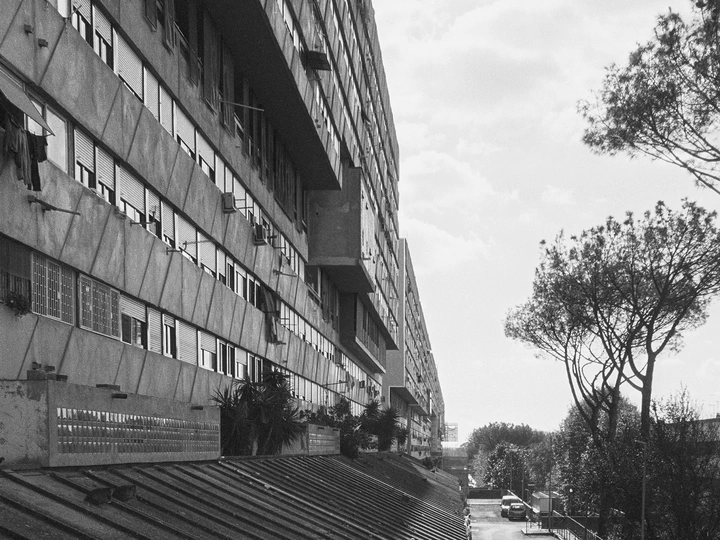
Sixty years ago, large housing estates were set to transform society – including the way we live – with their enormous capacity and potential to reimagine communal living. However, this architectural typology was heavily criticised from the outset. Today, these reinforced concrete structures resemble derelict fragments of a bygone era. What stories lie behind them? What hidden potential do they hold, and what architectural interventions are needed to revitalise them?
To answer these questions, I am conducting an in-depth study of several large housing estates in Italy. The research will analyse the original design concepts within their historical context, focusing on the architects' core mission of maximising communal space. Over time, these shared areas have been systematically neglected. Today, they require urgent intervention.
My project addresses this issue by proposing a scalable framework. This ranges from low-threshold, tactical interventions – such as clear signage and improved lighting – to permanent architectural upgrades, including circular refurbishment, additive extensions and radical structural adaptation.
Joining the LINA platform will enable me to expand this research in Italy and across Europe. Through the network, I intend to bridge the gap between theory and practice by carrying out the first intervention projects as well as using exhibitions and publications to raise public awareness. I want to change the way these estates are viewed, reframing them as vital assets for sustainable future housing – not just for the current tenants, but also for the local community and visitors.