The Public Architect
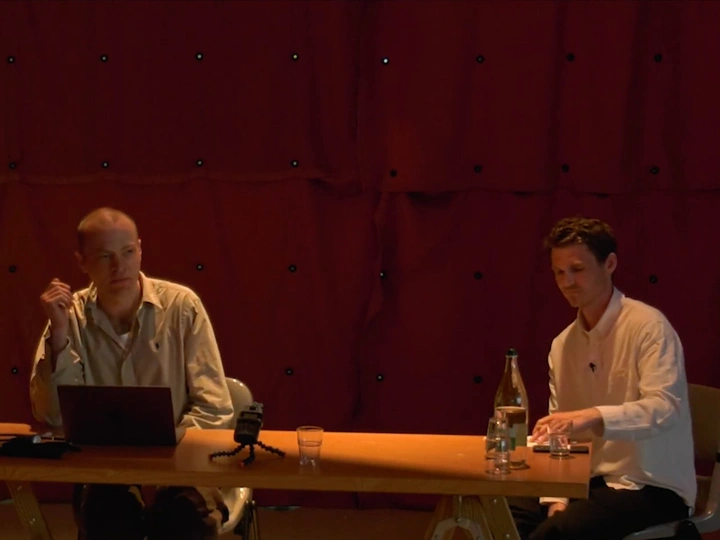
Jakob Walter is based in Zurich. He studied architecture in Leipzig, Weimar and Zurich, graduating from the Bauhaus Universität Weimar in 2021 with Cohabitation Podcast, a six episode investigation into whether houses might be protected from demolition by providing habitat for endangered species. The project explored this question through interviews and the construction of a habitat for brown long eared bats in his own building.
He is part of the ZAS* (Zürcher Arbeitsgruppe für Städtebau), contributing to the city’s urban design and planning discourse while working to strengthen connections between architects and public administration. At ETH Zurich, he teaches and conducts research at the Chair of Architecture of Territory. As a lecturer, he is responsible for sessions in the Sessions on Territory guest-lecture series and works with students to map planning bureaucracies. He is currently co editing the book Agency: Architecture in the Civil Service (Hatje Cantz, forthcoming) with Dr Julio Paulos and Prof Milica Topalović.
His practice is grounded in a curiosity about who can design and proceeds largely through conversation. Through symposia, lecture series and podcasts, he brings practitioners, administrators and publics into shared debate. His projects include the Demolition Symposium and Lobbyist Symposium at ETH Zurich, the Zoopolis events for ARCH+, and the Horizonte lecture series in Weimar.
From 2021 to 2023, Walter was an editor at ARCH+, where he led the magazine’s event series and served as lead editor of issue 251, Unternehmen Architektur, which examined how commercial interests within architecture offices shape design. In 2025, he realised Hamburg Räumt auf?, a public sculpture, streetlamp and audio walk, with Niclas Riepshoff.
Across these formats, his work examines the relationships between architecture, bureaucracy and public life through research, interviewing and collective discussion.
According to the ACE, approximately 10% of European architects work for public authorities. However, many of them don’t work as designers, as the design of public infrastructure has increasingly been outsourced. Public architectural practice still exists, but it has become largely invisible. This project seeks to uncover the design work of public architects across Europe.
A well known example of a public architecture office are the architects at IBAVI. In collaboration with the local construction industry, they realised several social housing prototypes in the Balearic Islands using local materials. In doing so, they developed a new approach to low emission social housing that is local, affordable with innovative design. IBAVI demonstrates how public architects can innovate architecture beyond the limitations of privately commissioned practice.
Large scale public in-house projects how ever are rare. Far more common are the public architects who continuously adapt and improve existing public buildings through repairs, extensions and other interventions. Across Europe, municipal building departments employ architects to design small projects in-house. Zurich’s Gruppe Express-Projekte is one example. Its ten architects maintain, repair and improve the city’s 3,000 public buildings continuously. Their design green roofs for school cafeterias and shade structures for kindergartens.
Finding these architects is difficult. Their work is rarely documented, and most do not have websites. The only way to learn about their practice is through direct conversation.
The proposed project will travel across Europe through a series of conversations with public architects. These encounters will be documented in a European atlas of public architectural practice. The project will create connections between largely isolated practitioners and document how public architects design the ongoing repair and adaptation of our built environment beyond the pressure to generate private profit.