Humanizing spaces in healthcare environments
Cristina Seguido Ramos
Alba Zarza Arribas
We are an interdisciplinary team from Rey Juan Carlos University (URJC) working at the intersection of architecture, design, art, and social innovation. Our practice explores how creative and spatial interventions can improve wellbeing, strengthen community connections, and transform everyday environments through participatory and care-centred approaches.Imelda Campos Izquierdo is a designer, researcher, and lecturer focused on social design, visual communication, and participatory methodologies. Her work connects design with healthcare, education, and community engagement. Alba Zarza Arribas is an architect interested in regenerative design, adaptive reuse, and the social and environmental impact of the built environment. Cristina Seguido Ramos is a sculptor and lecturer whose practice investigates materiality, spatial perception, and artistic interventions as tools for social connection. Together, we develop collaborative projects that combine research, design, architecture, and artistic practice to address real societal needs. Our methodology is grounded in participation, bringing together communities, institutions, and end users to co-create meaningful and context-sensitive solutions.One of our most significant projects is Designing for Care, developed in collaboration with Hospital Universitario del Tajo. Through participatory research involving patients, healthcare professionals, and students, the project transformed healthcare environments into more welcoming and emotionally supportive spaces. It demonstrated how low-impact interventions can foster wellbeing, strengthen social bonds, and humanise public infrastructures. Our shared interest lies in understanding care as a spatial practice and exploring how architecture, design and art can contribute to more inclusive, resilient, and regenerative futures. By working across disciplines, we aim to develop innovative methodologies that connect creativity, and social responsibility.
Designing for Care: Spatial Narratives for Regenerative Wellbeing
Designing for Care explores how design, art, and spatial practices can improve wellbeing in environments shaped by vulnerability and long-term care. Developed with Hospital Universitario del Tajo (Madrid), the project responds to the need for more human-centred healthcare spaces.
The research focused on the nephrology and dialysis unit, where patients spend many hours each week undergoing treatment. Through interviews, observation, and participatory workshops with patients, relatives, and healthcare professionals, the project examined how space influences wellbeing, belonging, and emotional experience. This process revealed the importance of integrating personal narratives, local identity, and community memory into healthcare environments.
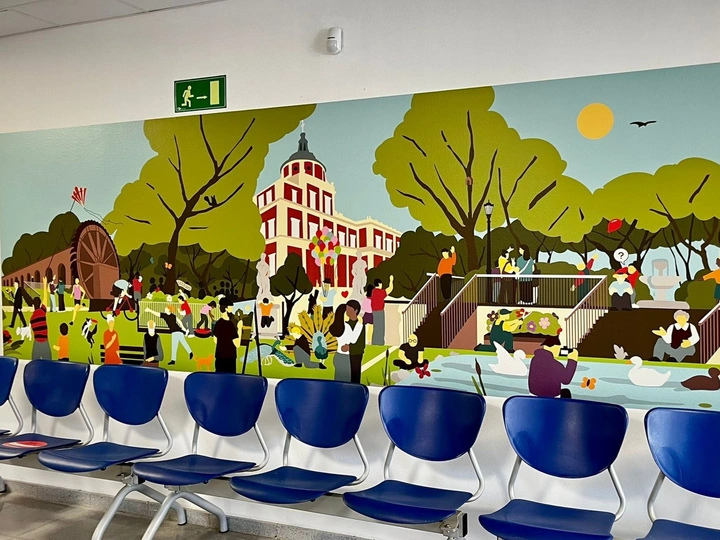
The outcome was a series of large-scale visual interventions inspired by the cultural landscape of Aranjuez and the experiences of patients. Rather than serving as decoration, these installations function as spatial narratives that encourage reflection, connection, and a more welcoming atmosphere. The project demonstrated how design can become an infrastructure of care, strengthening social bonds and transforming institutional spaces.
The proposal submitted to LINA seeks to expand this research into a transferable methodology for regenerative spatial practices. It explores how an ethics of care can guide the transformation of existing public infrastructures through participatory and low-impact interventions. Instead of producing new buildings, the project focuses on reactivating existing spaces and fostering social cohesion.
Situated at the intersection of architecture, social design, and participatory art, the project aligns with the regenerative values of the European Green Deal and promotes care as a key principle for creating more inclusive and sustainable futures.