Waste-Grown Architecture
Based in Zurich, working at the intersection of spatial practice, material research and food. The practice treats impermanence as a deliberate position, against accumulation, against formal permanence, and using perfomances as a tool to question how we live?
Work includes FUSE, a self-funded exhibition and social space in Zurich that brought together a young local scene of artists, designers and makers with almost no budget or institutional backing. It also includes material research developing biodegradable architectural elements from agricultural waste, currently being tested and produced as a curtain installation at Villa Saroli in collaboration with a local winery, with a public opening in October 2026.
Teaching includes five years at ETH Zurich, a course on food at the Oslo School of Architecture and Design in 2025, and a course on supermarkets and systems of provisioning in Antwerp. Across teaching and practice, the underlying interest is in low-threshold, temporary spatial situations that are publicly accessible and materially honest about where they come from and where they go.
Waste-Grown Architecture is a material research practice developing biodegradable building elements from food and agricultural waste, including pomace, husks, peels and spent grain, for use in temporary architectural structures such as curtains, panels, partitions and surfaces.
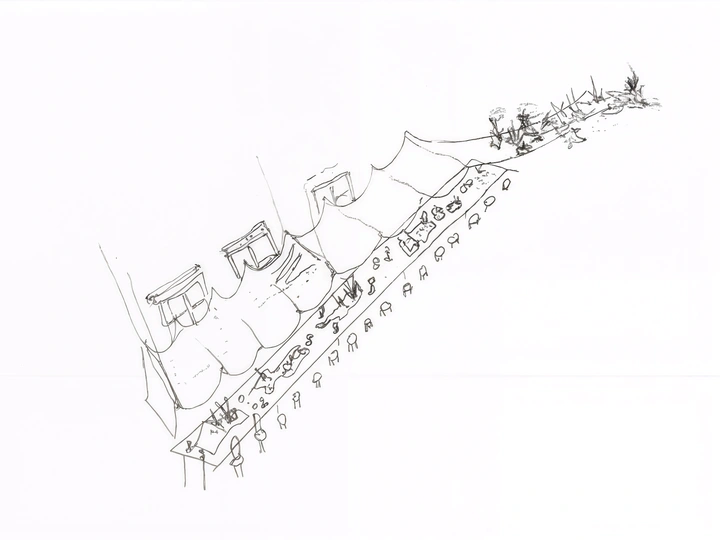
The work began with a question: what if a building material's lifecycle mirrored the waste stream it came from? Testing started with wine pomace and agar-agar, developed as a curtain installation at Villa Saroli for the Biennale del Territorio, Material tests have confirmed the method at panel scale. The installation, six panels suspended on a magnet-based system forming a walk-through passage, will be built and produced through autumn, timed to the local grape harvest, and inaugurated at a public opening in October, where the material can be touched, shared and eaten.
What's proving most successful so far is the collapse of categories the project enables. The piece is designed to function simultaneously as architecture, food and ritual, with its temporariness treated not as a limitation but as a deliberate position against accumulation and permanence. Nothing will remain after the event; every element is removed and biodegrades back into the cycle it came from.
The next phase, beyond this first realisation, is to move from a single site to a repeatable method: a material system adaptable to different waste streams such as brewing, market, dairy or harvest, and to different institutional and climatic contexts, each time built through a public, hands-on process from material testing to communal build to shared consumption.
I initiated this work because I wanted architecture to stop being separate from the systems, food, agriculture, waste, that actually shape a place. My background spans food scenography, curation and community building with FUSE in Zurich and material practice. This project is where those things meet.