The Anthropocene Apartment
Pavla Šimková
Anna Vazačová
ATELIER HOLCNEROVA
Atelier Holcnerova is an architecture practice based in Lisbon, founded in 2015. Its work brings together architecture, urban rehabilitation, and renewable energy, with a particular interest in the relationship between construction, landscape, and water. The practice focuses on the adaptive reuse of buildings, exploring the memory and materiality of the built environment.
The collective behind the proposed project — Holcnerová, Šimková, and Vazačová — previously collaborated on How Heavy Is a City? for the Lisbon Architecture Triennale 2025. Their project Anthropocene Apartment transformed a Lisbon apartment into a multidisciplinary laboratory dedicated to the Anthropocene, examining domestic energy metabolism and proposing sustainable architectural responses.
LENKA HOLCNEROVÁ (1986)
Architect and founder of Atelier Holcnerova. Her work focuses on the relationship between urban environments, coastlines, land, and water. This research originated in her award-winning master’s thesis, Between Sea and Land: Urban Coastline as a Source of Renewable Energy (2013), which proposed a coastal public space generating energy from waves while protecting against sea-level rise.
PAVLA ŠIMKOVÁ (1986)
Environmental historian based in Munich. Her research focuses on environmental and urban history, with particular attention to islands and coastal environments. She is the author of Urban Archipelago: An Environmental History of the Boston Harbor Islands (University of Massachusetts Press, 2021).
ANNA VAZAČOVÁ (1997)
Czech architect based in Lisbon. Her work explores the relationship between architecture, landscape, and material flows, with a focus on locality, reuse, and environmental transformation. In her master’s thesis, she investigated what it means to build locally in the contemporary city, examining material reuse as both a design strategy and a way of rethinking urban development.
Anthropocene Apartment explores how existing urban interiors can become laboratories for a post-extractive future. Rather than asking what new architecture should be built, the project investigates how cities can work with what already exists: existing spaces, discarded materials, local resources, and overlooked material flows.
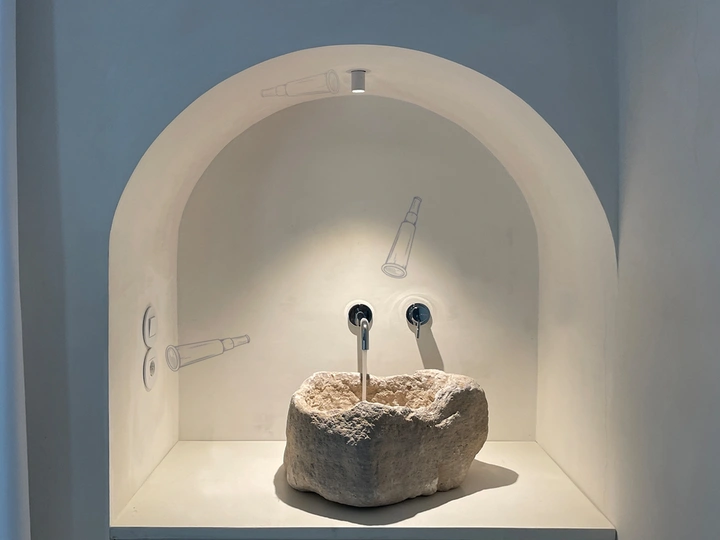
Set within a Lisbon apartment, the project proposes a methodology for transforming interiors with minimal environmental impact. Existing spatial configurations are preserved, while new interventions are lightweight, reversible, and designed for future reuse. Furniture, lighting, and spatial elements are created from reclaimed materials sourced within the city, including stone offcuts, demolition timber, abandoned tools, and fishing nets.
Beyond material reuse, the project addresses a broader cultural challenge: the waste generated by temporary exhibitions and short-lived installations. Anthropocene Apartment treats exhibition-making as a permanent layer of the interior rather than a disposable event. Objects, displays, and infrastructure remain in use after the exhibition, extending their life and eliminating waste.
The proposal seeks to demonstrate that architecture can operate as a process of transformation rather than replacement. By mapping local material cycles and embedding reuse into spatial design, it offers a replicable model for reducing resource consumption while strengthening the relationship between people, places, and the material ecologies of the city.