The Tent / Re-assembling the architectural canon
After graduating from EPFL in 2016, I collaborated for nine years with OFFICE Kersten Geers David Van Severen, where I led OFFICE 176 — Media House, the new RTS multimedia production campus in Ecublens — from early design through completion in 2025. Nowadays, I produce independent architectural work under the interchangeable pseudonyms 00XX / XX00 / X00X / 0XX0 / 0X0X / X0X0, in frequent collaboration with others. Earlier personnal built work includes a 2018 event tent in a French orchard (with Almost Studio) and a 2012 self-built renovation of a Mayen in Valais.
In parallel, I teach and conduct research as scientific assistant to Prof. Laurent Stalder at gta / ETHZ, following earlier assistantships with Prof. Koenraad Dedobbeleer and Prof. Kersten Geers at EPFL. I have published articles in magazines such as San Rocco, CARTHA, PAV Living Room, Werk, Bauen & Wohnen and Paprika!.
I hold a Bachelor and Master of Science in Architecture from EPFL (2014–2016, with the Prix de la Section d'Architecture, Prix de l'Institut d'Architecture, Prix Orlando Lauti and Prix BCV), including an exchange year at TU Delft. I am a comfortable speaker of Greek, French and English, a sailor since age 8, and active in cultural organizing, including co-organizing and curating the Fey Arts festival in Burgundy, France.
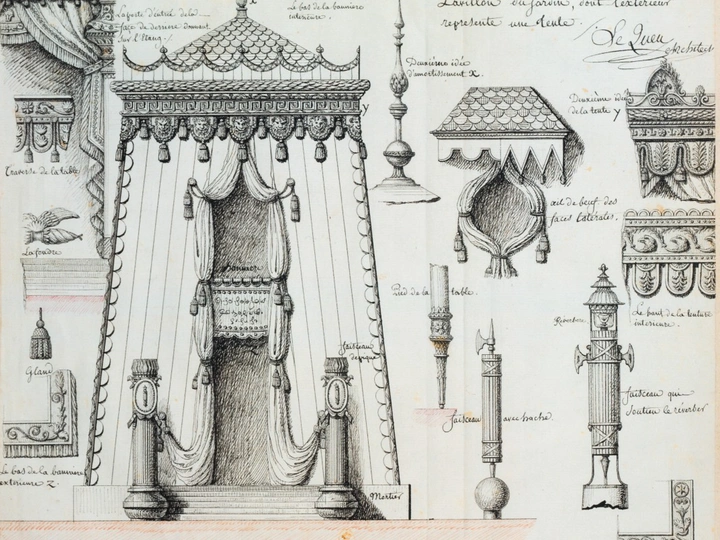
Quatremère de Quincy, in his 1788 Encyclopédie Méthodique, proposes that the occidental architectural canon isn't an unavoidable continuity but one possible lineage among others. "Our" canon derives, in his analysis, from the "cabane": the balanced, measured solidity he considers naturally dominant. Next to it stand two other possibilities: the cave, ancestor of the Egyptian tradition of plain massivity, and the tent, ancestor of an Eastern architecture of articulated lightness.
Since the late 18th century, disciplinary knowledge has broadened well beyond the canon of temples, churches and palaces, to an ever-expanding field of types and practices, technical and vernacular alike. Yet, perhaps in a modernist spirit, we still treat this body of knowledge as anecdotal, liquid, without the strength of a canon as a system of coordinates and a network of ancestries, arguments, counter-arguments.
Today, in the age of planetary limits, we need to look no further than Quatremère's tent to find potential intellectual tools to adapt to the emergency; the framework is already there to start forming a continuity of nimble, reversible and adaptable built objects.
Since first formulating it in my 2016 EPFL thesis under K. Geers and R. Gargiani, I have kept this framework alive mostly informally: through debate, a personal collection of references, close study of historical texts and treatises, and punctual lectures and publications. I see real potential for the LINA network to carry this proposal further, through debate, exchange and collaboration — the idea being, at this stage, too broad and speculative for a purely academic setting. Similar work has been proposed within the network in the past, most closely in Alessandro Pasero's "Ephemeral Permanence". My own proposal would build upon his and others, with a strong focus on building a broad imaginary with a canonical ambition.