Material Diplomacy: Contact Zones
Augustina Lavickaitė
Augustina Lavickaitė: I am a visual researcher using image, sound, and text to explore how witnessing and remembering take shape in objects and landscapes. My practice often uses archiving, both as a source of material and as a format: I collect new and found materials and assemble them into narratives. My work has been presented at Art Rotterdam, Salone del Mobile, Milan, Bundeskunsthalle, Bonn, the Museum of Applied Arts and Design, Vilnius, and Dutch Design Week. In 2024 I received the Young Designer Award from Vilnius Academy of Arts and in 2026 I was part of the ARCUS project residency in Moriya, Japan. I collaborate with institutions including Nieuwe Instituut in the Netherlands and is supported by Creative Industries Fund, Nordic Culture Point, and Cultuurfonds.
Pyeori Jung: My work explores memory of spaces, materials, and personal surroundings through installations, exhibitions, and objects. With a background in product and interior design and a master’s in Contextual Design from the Design Academy Eindhoven, my practice often translates lived experience into tactile, scenographic forms. I’ve presented work at venues such as Huidenclub, Milan Design Week, Collectible Brussels, and Art Rotterdam, developing exhibitions that reflect on ritual, affect, and politics of objects in daily-scale.
Lavickaitė and Jung investigate moments when diplomacy becomes tangible through objects, architecture, and protocols.
Their prior research examined diplomatic gifts as a lens for power dynamics and international relations. Through a case study of objects gifted to and by the Holy See, they worked with Vatican Museums, Library, Archives, Embassies, and Gift Shop, to trace the life span of the gift and the many definitions of value. The research looked at how objects, from everyday artifacts to national symbols, embody power, belief, and identity. This work ended in a Research Night at Nieuwe Instituut (Rotterdam), co-organized with Delany Boutkan and co-hosted by Suzanne Schols, Nadim Choufi, and Prof. Łukasz Stanek. More information here: https://nieuweinstituut.nl/en/events/research-night-material-diplomacy
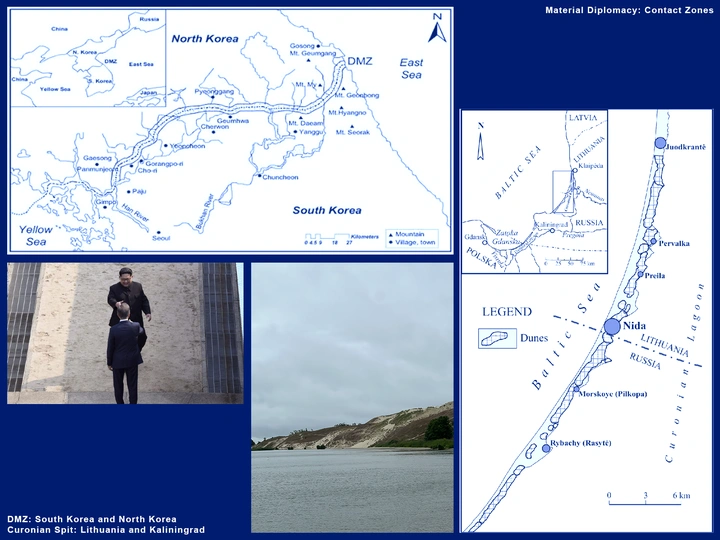
During the LINA fellowship, we want to expand beyond the gifted object and investigate “contact zones” – diplomacy as it materializes in places of geopolitical boundaries and natural landscapes. Initially comparing South Korea’s Demilitarized Zone (DMZ) with Lithuania’s Curonian Spit, this direction would examine how border environments are used as placeholders for political narratives of fear, hope and possible futures. Framed as a wildlife sanctuary, the DMZ is a hyper-monitored landscape where political narratives are projected according to the needs of the two regimes. However the border is still at the mercy of nature: annual typhoon floods mobilize the terrain, displacing landmines down valleys, and making the entire area beyond the control of either regime. On the Baltic coast, the Curonian Spit dunes separate Lithuania from russia’s militarized Kaliningrad exclave. Similarly as the DMZ, unstable nature and asymmetrical powers characterize the unique, heavily choreographed and designed space.
By analyzing global tensions through a material lens, we aim to bring spatial and design perspectives to topics typically reserved for politics and history.